HSG173: How to Monitor Workplace Exposure to Hazardous Substances
HSG173 is the HSE’s guidance on planning workplace air monitoring, and it is the framework most occupational hygienists work from. If you need to show that employees’ exposure to dust, fume or vapour stays within legal limits, or you've recently received a complaint, knowing how HSG173 works helps you avoid paying for the wrong kind of testing.
Our Workplace Exposure Limits testing service measures that exposure against the limits in EH40.
What is HSG173?
HSG173, Monitoring strategies for toxic substances, is HSE guidance on deciding whether to monitor airborne contaminants, how to sample them, and how to interpret the results. It is guidance rather than law, but it describes recognised good practice for meeting your duties under COSHH (the Control of Substances Hazardous to Health Regulations 2002).
The limits it helps you test against are workplace exposure limits (WELs), the maximum airborne concentrations of a substance that employees may breathe, listed in HSE’s EH40/2005. A WEL is usually an 8-hour time-weighted average (TWA), a 15-minute short-term exposure limit (STEL), or both.
When do you need workplace exposure monitoring?
Monitoring is needed when you can’t otherwise show that exposure is adequately controlled. COSHH requires it where it is necessary to maintain adequate control or protect employees’ health, and many substances don’t need it at all.
In practice, the usual triggers are:
- A risk assessment that can’t conclude whether exposure is below the WEL
- A change of process, substance or control measure
- Employee complaints or ill health that could be work-related
- A need to confirm that controls, such as local exhaust ventilation, are working
Substances such as respirable crystalline silica are classic cases, as are welding, soldering and other industrial fume sources.
The HSG173 monitoring process
HSG173 sets out a staged approach so that effort is proportionate to risk. In outline:
- Initial appraisal: gather what is known about the substances, processes, tasks and existing controls, and decide whether monitoring is needed at all.
- Basic survey: take a limited set of measurements to see whether exposure looks clearly low, clearly high or uncertain.
- Detailed survey: where the picture is uncertain or close to the limit, take enough representative samples to reach a defensible conclusion.
- Routine monitoring: repeat measurements where needed to confirm that controls keep working.
Not every site goes through all four stages, and a clear result early on can end the process.
Using HSG173 for common workplace dusts and fumes
The HSG173 approach applies to any airborne substance with a workplace exposure limit, but what you sample for, and how, changes with the substance. Where the source is unclear, identifying what is actually in the air comes first, which is why industrial fumes often need more investigation than a single known dust.
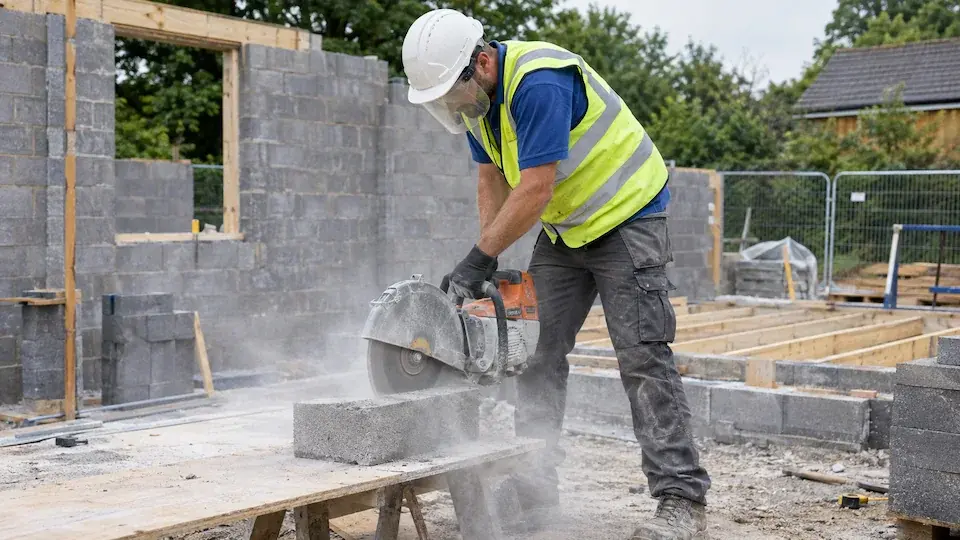
Respirable crystalline silica is measured as the fine fraction of dust that reaches deep into the lungs, not total dust, and samples are analysed in a laboratory. Cutting, grinding or drilling stone, concrete, brick and mortar are the usual sources.
Wood dust exposure varies widely between sanding, sawing and cleaning, so grouping workers by task matters. Hardwood dust in particular is treated as a carcinogen under COSHH.
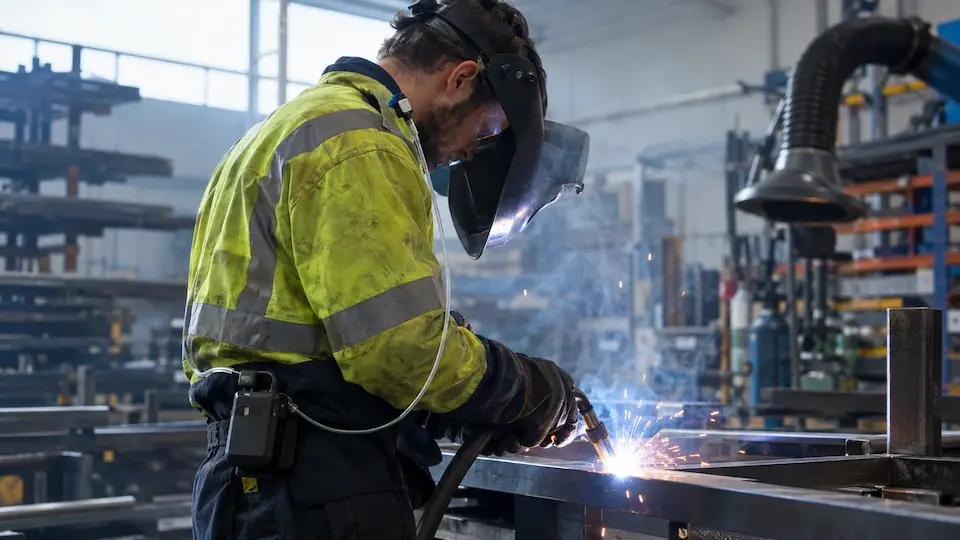
Welding fume is a good example of why “no visible smoke” proves nothing. HSE has stated that all welding fume, including from mild steel, can cause lung cancer, and exposure depends heavily on the task, the material and whether the work is in an open workshop or a confined space.
Rosin-based solder flux fume (colophony) is a respiratory sensitiser. Once someone is sensitised, low concentrations can trigger asthma, so monitoring is only one part of the control picture.
Glue fumes from solvent-based adhesives are rarely a single chemical. Each solvent has its own limit, so the product’s safety data sheet is the starting point, and the mixture has to be assessed as a whole.
Plastic fumes from heating, cutting, moulding or 3D printing are a changing mix of vapours and fine particles that depends on the polymer and the temperature. Working out which material and process you are dealing with comes before deciding what to sample.
Generator fumes from petrol and diesel units include carbon monoxide, nitrogen dioxide and fine particles. Carbon monoxide is the immediate danger when a generator runs inside or beside an enclosed space, because it is odourless and builds up quickly.
Personal sampling and similar exposure groups
Compliance measurements are normally taken with personal sampling: a pump worn by the employee, with the sampling head fitted near the nose and mouth (the breathing zone). Static sampling has its uses for tracing sources, but it tells you more about the shelf than the person.
Because testing every worker is rarely practical, employees doing similar tasks in similar conditions are grouped into similar exposure groups. Samples from the group represent everyone in it, so the groups need to be sensible and the sampling needs to cover normal working conditions, including the dustier or smellier tasks.
Sample duration also matters. Measurements must reflect the WEL’s reference period, so a 15-minute STEL needs short-term sampling, not an 8-hour average.
Comparing results with WELs
A result below the WEL is encouraging, but a single sample on a good day is not proof of compliance. How confident you can be depends on how many samples you took, how much results varied, and how close they were to the limit. Results well below the limit are straightforward, while results near or above it call for a review of controls and usually further sampling.
HSG173 dates from 2006, and the European standard BS EN 689, which covers measuring exposure by inhalation against limit values, has been revised since. Check which approach your contractor is working to.
Our guide to HSWA 1974 and WEL compliance covers the wider legal duties.
How often should you repeat exposure monitoring?
Repeat monitoring when something changes or when previous results were close to the limit. A new process, substance, extraction system or working pattern can alter exposure, and so can deteriorating controls. Low results with stable conditions justify longer gaps, while results approaching the WEL justify shorter ones. Your risk assessment should record the reasoning.
Standards and guidance are revised from time to time. Please verify figures, wording and document editions against the current HSE publications before relying on this article.
Get in touch
If you need to measure employee exposure against WELs, talk to an expert about our WEL testing service.