
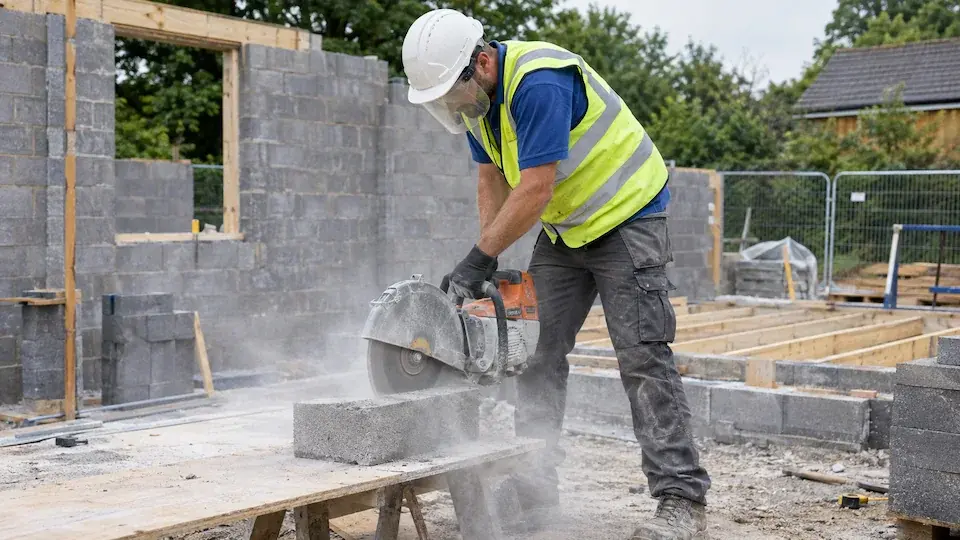
What Is Silica Dust and When Should You Test for It?
Silica dust is the fine, invisible dust released when concrete, brick, stone and similar materials are cut, drilled or ground, and breathing it in can cause serious, irreversible lung disease. This guide explains what it is, where it comes from, the health risks, the UK exposure limit, and when it is worth measuring what your workers actually breathe in with silica dust exposure testing.
What is silica dust?
Silica dust is airborne dust that contains crystalline silica, a natural mineral found in most rocks, sand and clay. The mineral becomes a risk when work breaks it into fine particles known as respirable crystalline silica (RCS), which are small enough to reach deep into the lungs. HSE's EH40 workplace exposure limits list groups quartz, cristobalite and tridymite dusts under the same RCS entry.
HSE says RCS is too fine to see in normal lighting. The absence of a visible cloud therefore tells you very little about what is in the air, and a visible cloud is a warning sign rather than a measurement.
Where is silica dust found?
Silica dust comes from any material that contains silica, and the amount varies a lot between materials. HSE gives these typical silica contents:
|
Material |
Typical silica content |
|---|---|
|
Sandstone, gritstone, quartzite |
More than 70% |
|
Concrete, mortar |
25% to 70% |
|
Slate |
Up to 40% |
|
Brick |
Up to 30% |
|
Granite |
Up to 30% |
|
Limestone, chalk, marble |
Up to 2% (but can contain silica layers) |
|
Engineered stone (worktops) |
Up to 95% |
Source: HSE silicosis guidance and the HSE engineered stone announcement.
The dust is produced by cutting, drilling, grinding and polishing. HSE lists quarrying, slate works, foundries, potteries, stonemasonry, construction work on stone, concrete or brick, and industries using silica flour as occupations with RCS exposure. Refurbishment and strip-out inside occupied buildings sit within that construction category.
What are the health risks of silica dust?
Breathing respirable crystalline silica can cause silicosis, lung cancer and chronic obstructive pulmonary disease (COPD). The damage is often irreversible, and it can keep developing after exposure has stopped.
Silicosis
Silicosis is scarring of the lung tissue that causes loss of lung function and severe shortness of breath. HSE says the effect continues to develop after exposure ends and cannot be reversed, and that people with silicosis also face a higher risk of tuberculosis, kidney disease and arthritis. Acute silicosis is rare, follows short-term exposure to very large amounts of silica, and is life-threatening.
Lung cancer
Lung cancer is the other major concern. HSE describes silica as the biggest risk to construction workers after asbestos, and HSE-commissioned estimates linked it to the deaths of over 500 construction workers in 2005.
COPD
COPD causes chronic cough, sputum production and breathlessness. It is slow to develop and rarely seen in people under 40. HSE estimates around 4,000 deaths a year from COPD caused by past workplace exposures, with construction workers a significant at-risk group. That figure covers all workplace dusts and chemicals, not silica alone.
Why is engineered stone a particular concern?
Engineered stone, widely used for kitchen and bathroom worktops, can contain up to 95% crystalline silica, and HSE says exposure to its dust can cause silicosis within months or years rather than the decades seen with natural stone.
In May 2026 HSE published its first COSHH guidance sheet for engineered stone and announced more than 1,000 inspections of fabricators over the next year. Its research found that dry fabrication typically exposes workers to five to ten times more RCS than wet methods. The guidance expects low-silica material, on-tool water suppression with mist controlled, suitable respiratory protective equipment (RPE) and regular health surveillance. HSE is clear that this is guidance under existing COSHH duties, not a new law or a formal ban. In June, HSE reported that businesses had been ordered to stop work with engineered stone after failing inspections.
What is the UK workplace exposure limit for silica dust?
The UK workplace exposure limit (WEL) for respirable crystalline silica is 0.1 mg/m³, measured as an 8-hour time-weighted average (TWA). That means exposure averaged over a working shift, not a figure that must never be exceeded for a moment. This is listed in EH40/2005.
EH40 also gives RCS a Carc notation where the dust is generated by a work process, meaning it is capable of causing cancer. Under the Control of Substances Hazardous to Health Regulations (COSHH), control is only adequate if the WEL is not exceeded and exposure to carcinogens is reduced as low as is reasonably practicable. Staying under 0.1 mg/m³ is the minimum, not the target.
Why might you need to test for silica dust?
You need silica dust testing when you have to show what workers actually breathe in, rather than estimate it. There are five common reasons.
-
A COSHH assessment needs evidence. Employers must assess and control the risk from silica dust, and measured exposure data makes that assessment far more defensible than a guess. COSHH regulation 10 also requires monitoring in certain specified situations.
-
The limit can only be checked by personal sampling. EH40's limits relate to personal monitoring: a sample taken in the worker's breathing zone, calculated as an 8-hour TWA and compared with 0.1 mg/m³. A general dust reading from the room cannot do that job.
-
Controls need proving. HSE's finding that dry cutting can expose workers to five to ten times more RCS than wet methods shows how much a control can change the result. Testing shows whether the controls on your site perform as well as the guidance assumes.
-
Health surveillance depends on risk. HSE says health surveillance must be provided where workers are regularly exposed to RCS and silicosis may reasonably develop, and should be considered across construction, foundry work, brick and tile, ceramics, slate, quarries and stonework. Measured exposure helps you judge where you stand.
-
Anything that changes the dust changes the result. A new material, tool or cutting method is a good reason to re-test.
How can you reduce silica dust exposure?
The most effective step is to cut the amount of dust at source, then control what remains. HSE's construction dust guidance sets out the practical steps for site work. For engineered stone, HSE expects low-silica material, on-tool water suppression, suitable RPE and regular health surveillance. Dry cutting is the practice HSE wants to see stop.
Get in touch
If you need to know what your workers are actually breathing in, our silica dust WEL testing measures personal exposure against the 0.1 mg/m³ limit and tells you what to fix first. Talk to an expert to discuss your site.
Figures and guidance in this article were checked against HSE pages in October 2026. Standards and guidance are revised, so check the current HSE guidance and the latest edition of EH40 before relying on any figure.