- Expectations
- Featured Project
- Insights
Education Sector
The single biggest constraint we hear from education clients is budget. Full HVAC overhauls are rarely realistic, and many school buildings aren't designed for today's occupancy levels or airtightness standards. The good news: meaningful improvement doesn't require a full mechanical ventilation retrofit.
Starting with proper testing and monitoring data is an inexpensive first step that lets you target spend where it actually matters. We frequently find that a school's ventilation problem is behavioural and operational (windows not opened at the right times, AHUs not properly maintained) just as often as it's a hardware fault. Diagnosing which one you're dealing with changes the entire remediation plan and cost.
Schools should also be aware that funding routes exist specifically for this. In England, schools can apply for Condition Improvement Fund (CIF) support covering ventilation and heating upgrades; in Wales, separate maintenance funding is available.
Relevant services
- HVAC Maintenance
- Fire Damper Testing
- Water Quality Testing
- TM44 Inspections
- Grease Cleaning
- Ductwork Cleaning

Air Quality Testing in Surrey for a School's Ventilation Problem
Objectives
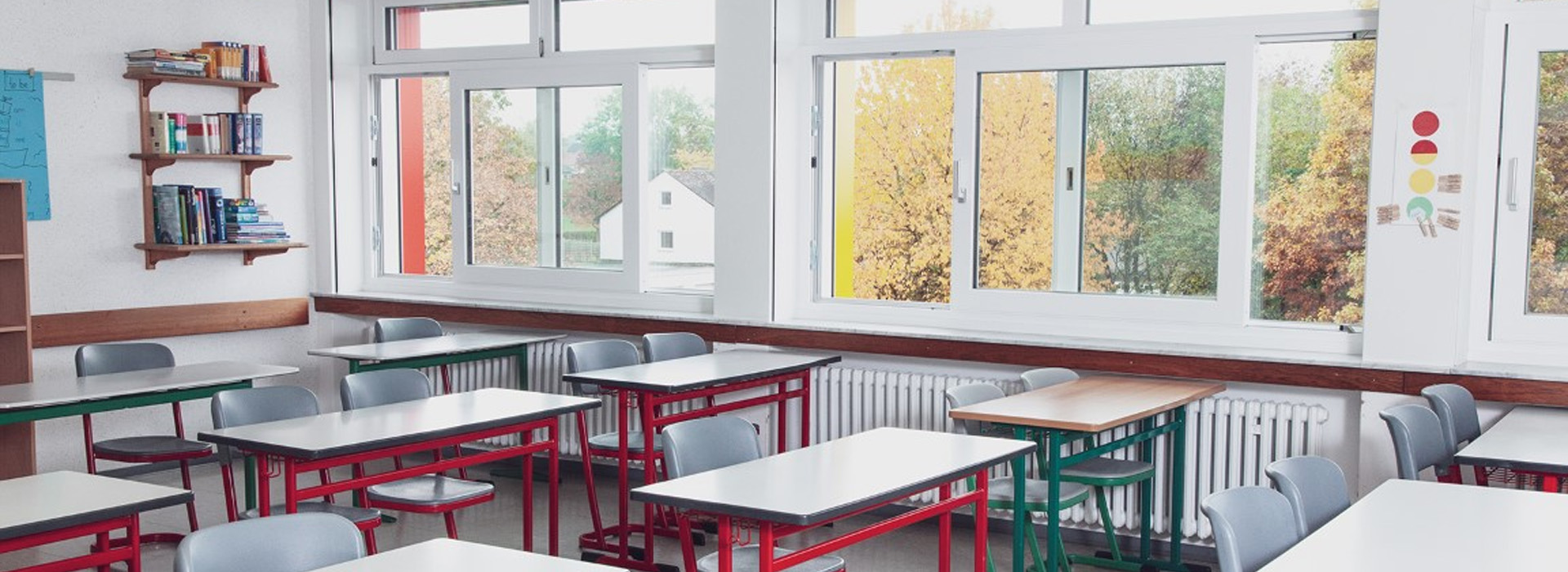
After a teacher at this school was diagnosed with long COVID in April 2024, resulting in wheelchair use, the school management team became justifiably concerned about the air quality and ventilation within their workplace. They contacted ARM Environments to request an indoor air quality (IAQ) test, in particular they wanted to know how effective their ventilation efforts were at improving air quality.
We deployed five 'Awair Omni' sensors around the school, across various class rooms and a staff room. This allowed us to gather plenty of data and create a representative snapshot of the air which students and teachers are breathing throughout the day. These sensors were capable of measuring five key components of indoor environment quality (IEQ): temperature, humidity, carbon dioxide, particulate matter, and total volatile organic compounds (TVOCs).
Solutions
It's worth noting that this school is in a rather rural area, so we expected the outdoor air quality (OAQ) to be healthy. Our measurements from the sensors showed excessive levels of carbon dioxide, regularly exceeding 2000 ppm. Particulate matter remained at a healthy level, possibly due to good OAQ. TVOC levels were low during unoccupied hours, but rose significantly when the rooms were occupied. The hand sanitiser used also contributed to a spike in TVOCs during this test. Humidity was within reasonable levels, however we recorded low temperatures in all of the rooms.
Overall, we determined that the school was not being sufficiently ventilated, shown by the sharp rise in TVOCs and carbon dioxide once the rooms were populated. Due to the low temperatures in our recordings, we discovered that teachers were hesitant to open windows for ventilation, because it would exacerbate their heating issue. This created a problem, though, as poor-quality, stagnant air would fill these classrooms without any source of ventilation to circulate clean air into the space. Despite the rural location, the staff would rarely introduce the clean outdoor air into the indoor environment, meaning air quality was being significantly compromised. We discovered that staff would only open a window once the temperature was too high, meaning the only ventilation many of these rooms received was in temporary bursts dependent on the weather.
Results
Understanding the IAQ risks associated with these populated classrooms, and the data to prove it, the staff were educated on the importance of using their window ventilation in the absence of a ventilation unit. The teachers now understood that carbon dioxide and TVOC levels became a health concern when rooms were not effectively ventilated, and all agreed to 'flush out' their classrooms each day. To make this option more viable, they also agreed to turn their heating on for longer during the day to ensure the temperature within these rooms didn't drop to uncomfortable levels.
Indoor air quality standards for schools must be kept to a consistently high standard, as it's important to remember that the government's Workplace Exposure Limits (WEL) and Control of Substances Hazardous to Health (COSHH) regulation are not designed with children in mind. IAQ in schools should be routinely assessed and remediations/maintenance should be performed without delay to avoid putting children's health at risk.
Challenges
- CO2 levels above 2000 ppm
- Children are particularly vulnerable to poor IAQ
- Absence of a ventilation system
"We were very concerned when we first took those sensor readings as we know how vulnerable young children can be to poor air quality. On top of that, we spoke to a teacher at this school who was in a wheelchair due to long COVID, something that poor IAQ might only make worse. The moral of the story here is that ventilation isn't only for temperature -- it's crucial to ventilate your spaces to remove harmful pollutants as well. Despite the teachers' reluctance to open windows on cold days, they unanimously decided to flush out their spaces after we informed them of the risks of poor IAQ for them and their students."
Adam Taylor, CEO of ARM Environments
Health
Education
Productivity
Related Insights
What are the Relevant Standards for Schools?
Relevant indoor air quality standards and guidelines for schools include:
-
BB101 — sets ventilation and thermal comfort design requirements for new and refurbished school buildings
-
DfE Operational Guidance — sets day-to-day CO2 thresholds for occupied classrooms (1,500ppm daily average; no more than 20 consecutive minutes above 2,000ppm)
-
COSHH Regulations 2002 — governs control of hazardous substances, including cleaning chemicals and science department fumes
-
EH40/2005 — sets Workplace Exposure Limits (WELs) for specific airborne substances
-
CIBSE TM57 — integrated design guidance for low-energy schools, used alongside BB101 by architects and M&E engineers
-
BESA DW172/TR19 Grease — kitchen ventilation and grease extraction compliance for school catering facilities
Why Choose ARM?