Diesel Generator Fumes: Air Quality Risks & Responsibilities Under COSHH
Diesel generators are a fixture of the modern built environment — from hospital backup systems and data centre UPS to construction sites and industrial facilities. They're reliable, they're ubiquitous, and they produce fumes that are classified as carcinogenic. For facilities managers, that combination creates a compliance obligation that is frequently underestimated.
This guide covers the pollutants diesel generators produce, where the legal duties sit, the mistakes that lead to poor outcomes, and what to do if you're concerned about exposure in your facility.
Related guide: Your Guide to Indoor Air Quality Testing [2026]
Relevant services: Indoor Air Quality Testing, Air Quality Monitoring, Ventilation Validation, WELs Testing.
What Pollutants Do Diesel Generators Produce?
Diesel engine exhaust emissions (DEEEs) are not a single substance — they're a complex mixture of gases, vapours, and fine particles produced during the combustion of diesel fuel. According to HSE guidance HSG187, the key components include:
Particulate matter — fine soot and carbon particles, including respirable PM2.5, which penetrate deep into the lungs and bloodstream. Historically, diesel engines have emitted substantially higher particulate concentrations than petrol engines (up to 10x), particularly where particulate filters are absent. See our PM2.5 and PM10 pollutant pages for more detail.
Carbon monoxide (CO) — a colourless, odourless gas produced by incomplete combustion. Even at low concentrations it causes headaches, nausea, and impaired cognition; at high concentrations it is rapidly fatal. More on CO here.
Nitrogen oxides (NOₓ) — including nitric oxide (NO) and nitrogen dioxide (NO₂), which irritate the respiratory tract and contribute to long-term lung damage.
VOCs and BTEX compounds — including benzene, toluene, and polycyclic aromatic hydrocarbons (PAHs), some of which are known carcinogens. See our BTEX VOCs and TVOCs pages.
Sulphur dioxide (SO₂) — produced when diesel fuel containing sulphur is burned. A respiratory irritant, particularly for people with asthma. More on SO₂.
Aldehydes — including formaldehyde and acrolein, both of which have very low workplace exposure limits and act as respiratory irritants and sensitisers.
The International Agency for Research on Cancer (IARC) classifies diesel engine exhaust as a Group 1 carcinogen — the highest classification.
Where Are Diesel Generators Used?
Diesel generators can be found across virtually every built environment sector ARM Environments works in:
- Healthcare and Laboratories — standby generators are mandatory in most NHS facilities; plant rooms are often in basements adjacent to occupied areas
- Industrial and Food Processing — both continuous and standby generation, often in partially enclosed or inadequately ventilated plant spaces
- Hospitality and Leisure — event venues and large complexes sometimes deploy generators as a temporary measure
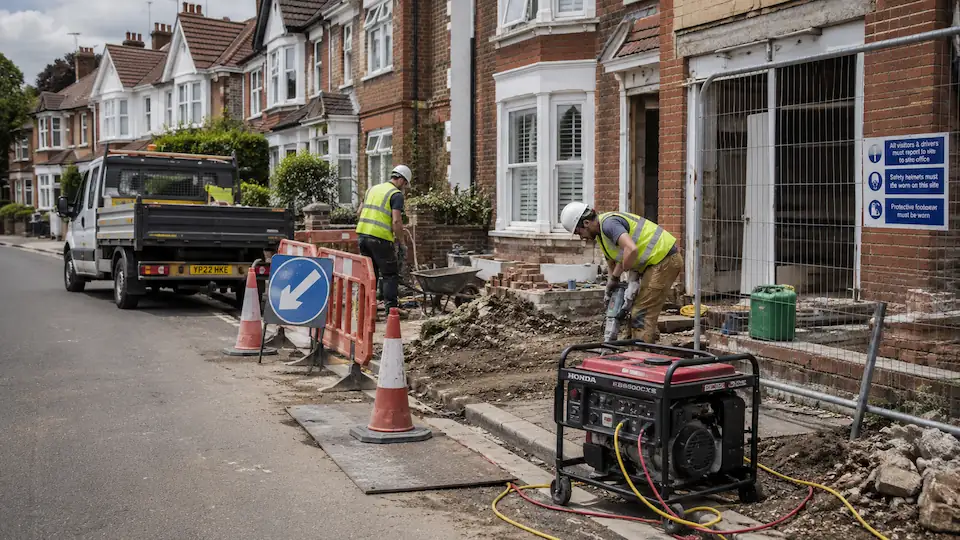
- Construction (All sectors) – remedial works to any building or road surface can see construction crews deploying outdoor diesel generators to power lights, tools, and other equipment. Fumes from these generators can drift indoors and become trapped in the spaces which people occupy daily.

Location is the critical variable. An externally sited generator with a dedicated flue and adequate separation from air intakes presents a manageable risk. The same generator running in a basement plant room with poor ventilation and air intakes drawing from the exhaust zone is a serious hazard — and a situation more common than facilities managers might expect.
How COSHH Applies to Diesel Generator Fumes
Diesel engine exhaust emissions are a substance hazardous to health under the Control of Substances Hazardous to Health Regulations 2002 (COSHH). That means the full COSHH framework applies: risk assessment, prevention or adequate control, monitoring, health surveillance, and documentation.
The exposure limit picture
HSE's EH40/2005 Workplace Exposure Limits sets individual WELs for the gaseous components of diesel exhaust. However, controlling exposure to individual gases to below their WELs does not fully address the carcinogenic risk from the particulate phase.
The EU introduced an occupational exposure limit of 0.05 mg/m³ elemental carbon for diesel engine exhaust emissions. Although this is not currently a UK WEL under EH40, many occupational hygienists regard it as a useful benchmark when assessing exposure. Given that DEEEs are classified as a carcinogen, the COSHH duty to reduce exposure to as low as reasonably practicable (ALARP) applies regardless of whether a formal WEL has been set.
Ventilation requirements
HSG187 sets out clear expectations for controlling DEEE exposure: the priority is engineering controls — exhaust extraction at source, adequate air supply and extraction in generator rooms, and ensuring that exhaust discharge points are positioned so that re-entry into the building via air intakes is prevented. Reliance on dilution ventilation alone is not adequate for enclosed or semi-enclosed generator installations.
Your COSHH duties in practice:
- A suitable and sufficient COSHH assessment covering DEEE exposure for all workers who may be in proximity to generators — including during testing and maintenance, not just normal operation
- Engineering controls confirmed to be adequate (ventilation design, exhaust routing)
- Air monitoring to verify that exposure levels are within acceptable limits
- Health surveillance for workers with regular, significant exposure
- Records retained and available to HSE on request
Common Mistakes and Problems
Treating testing as normal operation
Many standby generators run for only brief periods under test conditions — but these are often the periods of highest fume concentration, as the engine warms up and operates under variable load. COSHH assessments that only consider continuous operation at steady state may significantly underestimate actual worker exposure — that’s where long-term indoor air quality monitoring comes in.
Air intakes drawing from exhaust zones
Where generators are installed inside or nearby buildings, exhaust discharge is sometimes positioned too close to vent intakes or natural ventilation openings. Under certain wind conditions, this allows exhaust gases to re-enter the building — sometimes into occupied areas far from the generator itself. This is unfortunately very common, particularly when building layouts change.
Plant rooms treated as unoccupied spaces
Generator rooms and plant rooms are sometimes excluded from air quality management programmes on the basis that staff rarely enter. In practice, maintenance visits, testing attendance, and fault-response can result in significant cumulative exposure, and these spaces are covered by COSHH in the same way as production areas.
No re-assessment after modifications
Changing fuel type, upgrading to a higher-output generator, adding additional units, or modifying building ventilation can all significantly alter the fume exposure picture. A COSHH assessment that was valid for the original installation may no longer be adequate.
Relying on CO detection alone
Fixed CO detectors provide valuable safety protection but they don't give a complete picture of DEEE exposure. Carbon monoxide is one component of a complex mixture — you can have elevated particulate and NOₓ exposure without a CO alarm triggering.
What to Do if Staff Report Health Concerns from Generator Fumes
If workers are reporting symptoms that correlate with time spent near generator plant rooms or during generator operation, it should be treated as a potential DEEE exposure issue until demonstrated otherwise.
Symptoms include:
- Persistent headaches
- Eye or throat irritation
- Fatigue
- Respiratory difficulties
The next step is a professional air quality assessment. ARM Environments' indoor air quality testing service can identify the specific substances present and their concentrations, giving you the data needed to understand whether a health concern is justified and what action is required.
If workers are experiencing acute symptoms that may indicate CO exposure — confusion, loss of consciousness, or severe headache — this is a medical emergency. Evacuate the affected area and contact emergency services immediately.
See our pollutants page for more information.
How Is Generator Fume Testing Carried Out?
Effectively testing for diesel generator fumes requires a combination of approaches. Here’s a run-down of which methods we may use on-site to build an air quality report:
Point-in-time indoor air quality testing — usually involving handheld digital air quality sensors — can provide a snapshot of your space’s air quality to provide immediate answers to your IAQ concerns. This, however, does not always tell the whole story, as occupancy levels, time of day, ventilation schedules, nearby processes, etc. can alter the composition of the air drastically hour-by-hour.
Long-term air quality monitoring — often using passive sampling tubes or digital monitors over the course of a few days or weeks — provides insights into your air quality over a much more significant period of time. These results show how air quality changes throughout the day and can often be used to identify and diagnose issues with ventilation or pollutant-emitting processes.
Ventilation validation is typically conducted alongside air quality assessments to verify the efficiency of the HVAC system at ventilating the space. These surveys involve the measurement of airflow to check that the systems function as required for the space — moving enough air to keep the indoor pollutant concentrations at a minimum.
.webp?width=500&height=334&name=Air%20Quality%20Testing%20-%20web%20(1).webp)
See our page for more information on fume testing: industrial fume testing services
When to Call a Specialist
If any of the following apply to your facility, professional assessment is warranted:
- Your COSHH assessment for generator fumes has not been reviewed recently or following significant changes (we also strongly recommend an assessment every 12 months)
- Your generator is installed inside the building, in a basement, or in a plant room without dedicated mechanical ventilation
- Workers spend time in plant rooms or adjacent areas during generator operation or testing
- You have received health complaints that could be consistent with DEEE exposure
- Your facility is in a sector with heightened compliance expectations — healthcare, education, or critical infrastructure
Get in touch with the ARM Environments team to discuss your air quality concerns and arrange air quality assessments for your site.