![Your Guide to Indoor Air Quality Testing [2026]](https://www.arm-environments.com/hubfs/iaq%20testing%20in%20an%20office%20(1).webp)
Your Guide to Indoor Air Quality Testing [2026]
Indoor air quality (IAQ) can be a daunting topic for most business managers or property owners who were never actually taught what their responsibilities are. From Building Regulations to Workplace Exposure Limits, after hours of researching, many people eventually throw in the towel and harness the attitude "if something happens, I'll deal with it later.", but this can (and does!) land countless building managers in hot water due to negligence. Or, perhaps even more painfully, they get exploited by a contractor who promises that they need testing services for problems that never even existed in the first place.
Air quality doesn't have to be that stressful. When meeting with clients for the first time, we tend to advise some sort of indoor environment quality (IEQ) assessment first to properly understand their space, their requirements, and their challenges. Commonly, this assessment involves some sort of air quality testing so that we can understand which pollutants are in their space, the sources of this pollution, the times at which IAQ is at its worst, etc.
In this article, we'll cover what an indoor air quality test (also referred to as a survey, assessment, or audit) actually involves, who tends to need one, what usually prompts a test, and what happens once your results land.
Already know you need one? Head straight to our indoor air quality testing service. Otherwise, read on.
What is indoor air quality testing?
At its simplest, indoor air quality testing measures the pollutants present in the air inside a building, then compares them against recognised health, safety, or certification thresholds. You'll also see it called an IAQ survey or an IAQ test for brevity's sake — same thing.
A visual inspection can only tell you so much. An IAQ test produces actual numbers: pollutant concentrations, measured over a defined period, at specific points around the building. With that data in hand, "the air in here feels stuffy" turns into something concrete which you can act on, budget for, or use as evidence of compliance.
What does an IAQ test actually measure?
Depending on what's prompted the test, most assessments look at some combination of the following:
- PM2.5 & PM10: fine and coarse particulate matter, often from traffic pollution ingress, dust, or combustion.
- VOCs (Volatile Organic Compounds): off-gassing from paints, adhesives, furnishings, and cleaning products. Usually measured as a total (TVOC) because measuring individual compounds can be too complicated, costly, and inefficient.
- CO2: a proxy for ventilation effectiveness and occupant density. Carbon dioxide alone is typically not very dangerous, as long as there is adequate ventilation, but high CO2 can indicate elevated levels of other pollutants, too.
- Formaldehyde: a specific VOC of particular concern in new-build and fit-out environments. Common sources include off-gassing furniture and building materials, and can quickly cause health risks and compliance problems.
- Mould: relevant wherever there's a history of water ingress or condensation, or occupant complaints of respiratory concerns when they're inside the building.
Who needs an indoor air quality test?
People working across different sectors with different job titles all have different reasons to book an IAQ test. Here are four types of people who tend to commission IAQ testing:
- Facilities managers usually responding to occupant complaints or trying to get ahead of them before they arrive.
- Developers and project teams working towards BREEAM, WELL, or Fitwel certification who require indoor air quality/pollution/sustainability credits (e.g., BREEAM Hea 04).
- Employers and duty holders who need to demonstrate they've met their workplace health and safety obligations under the HSWA 1974 (e.g., Workplace Exposure Limits).
- Building owners carrying out due diligence ahead of a refurbishment, fit-out, or change of use, to prevent any health risks.
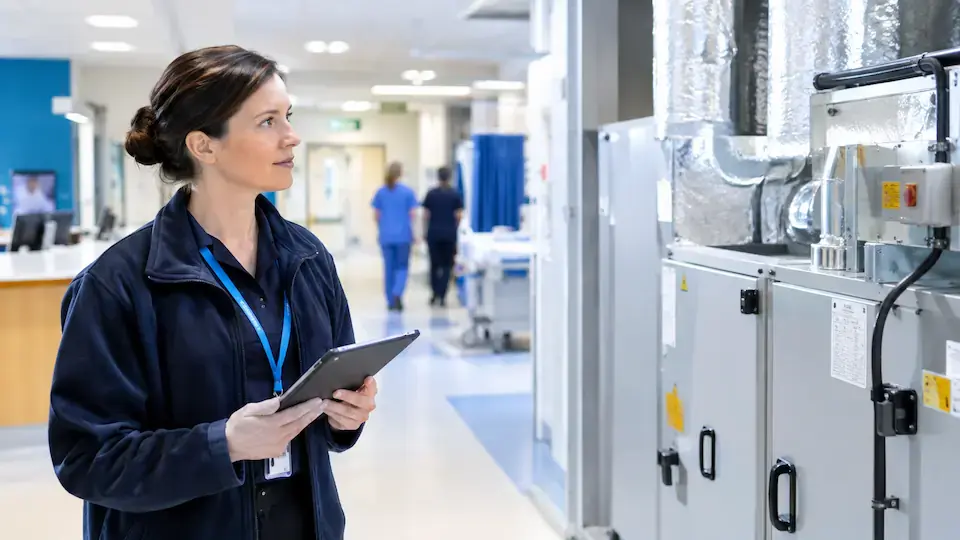
Schools, healthcare settings, and high-occupancy commercial spaces sit higher up this list than most. When the people breathing that air are children, patients, or hundreds of office workers packed into open-plan floors, the margin for getting it wrong shrinks considerably. In these spaces, it can be worth conducting an IAQ test just to be on the safe side, rather than leaving it to chance. Learn more about how we keep IAQ safe for vulnerable people.
What are the triggers for indoor air quality testing?
Air quality testing isn't something many clients schedule as a routine service; it's usually triggered by something. And that doesn't always result in the phone getting picked up immediately — oftentimes an IAQ test only gets booked once complaints or risks have reached a tipping point, after weeks or months of issues slowly presenting themselves. Here are the most common reasons why clients book an IAQ test with us:
- Occupant complaints: headaches, fatigue, persistent odours, or just a nagging sense that something in the building isn't right.
- Certification requirements: BREEAM, WELL, and Fitwel all build IAQ testing into their credit structures.
- Legal obligation: businesses must keep staff safe under the HSWA 1974, otherwise legal action can be taken against the employer. This includes keeping pollutants below a certain threshold (WELs), and an IAQ testing report is proof of pollutants being under control.
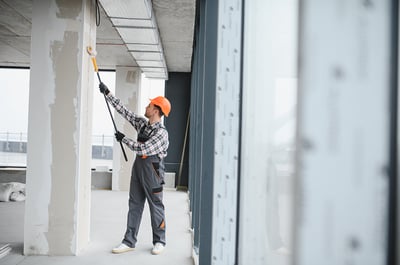
- Post-construction or post-refurbishment handover: checking new materials haven't left elevated VOC or formaldehyde levels behind.
- A change in building use: office space converting to residential, or occupant density simply going up. Layout changes can also cause misalignment in the ventilation strategy, leading to some spaces being under or over-ventilated.
- Routine due diligence: testing on a rolling schedule, without waiting for a specific problem to force the issue (uncommon).
Is indoor air quality testing a legal requirement?
IAQ testing is sometimes required under UK law, but the answer genuinely depends on your building. There's no single blanket law covering every space in the UK, but a number of routes push IAQ testing from "good idea" to "effectively mandatory."
The Health and Safety at Work Act 1974 and the Workplace (Health, Safety and Welfare) Regulations 1992 place a general duty of care on employers. COSHH applies wherever hazardous substances are present. And certification schemes like BREEAM require air quality testing as a specific credit requirement.
For the full breakdown of what's mandatory versus voluntary, and why that distinction matters more than most people assume, read our guide to Indoor Air Quality Audits: Mandatory vs Voluntary.
Which UK air quality standards apply to your sector?
Most UK workplaces carry a baseline legal duty to provide adequate ventilation, but the standards stacked on top of that can vary a lot by sector, from DfE guidance in schools to NHS-specific ventilation memoranda in healthcare.
Below is a sector-by-sector breakdown covering your indoor air quality responsibilities across sectors.
Air quality testing legislation across sectors
| Sector | HSWA 1974 & Workplace Regs 1992 | COSHH / EH40 (WELs) | Building Regs Part F (Ventilation) | Sector-specific guidance | BREEAM / WELL / Fitwel |
|---|---|---|---|---|---|
| Education | Always | Sometimes | Always | Always — BB101 | Sometimes |
| Healthcare | Always | Always | Always | Always — HTM 03-01 | Optional |
| Commercial Offices | Always | Sometimes | Always | N/A | Sometimes |
| Industrial | Always | Always | Sometimes | N/A | Optional |
| Hospitality | Always | Sometimes | Always | N/A | Optional |
| Leisure | Always | Sometimes | Always | Sometimes — PWTAG (pools) | Optional |
| Residential | N/A | N/A | Always | N/A | Optional |
| Laboratories | Always | Always | Always | Sometimes — BS EN 14175 / CLEAPSS | Optional |
| Food Industry | Always | Always | Sometimes | N/A | Optional |
| Retail | Always | Sometimes | Always | N/A | Optional |
A few notes on how to read this:
- HSWA 1974 & Workplace Regs 1992 cover any building where people work, placing a general duty on employers to provide adequate ventilation. It doesn't apply to private homes in the same way, which is why Residential sits out.
- COSHH / EH40 kicks in wherever hazardous substances are used or stored: solvents, dust, pool chemicals, cleaning agents. EH40 sets Workplace Exposure Limits for airborne concentrations. It's a given in labs, healthcare, and food production; but more situational in offices and retail (think print rooms or on-site cleaning stores). EH40 applies for all workspaces, but is less of a concern in low-risk rooms, unlike woodworking classrooms, science classrooms, or rooms with printers or cleaning chemicals.
- Part F is the baseline ventilation standard for any new build or major refurbishment, residential or not. But for existing buildings where no such works are planned, it isn't retrospectively enforced.
- Sector-specific guidance means a document written for that sector specifically. Schools have BB101, which sets CO2 thresholds and pollutant limits for teaching spaces. Healthcare has HTM 03-01, which governs air change rates, filtration, and pressure regimes in clinical spaces. Pools fall under PWTAG guidance, largely because of chloramine off-gassing above the water.
- BREEAM, WELL, and Fitwel are voluntary certification schemes, but "voluntary" doesn't mean rare — they're increasingly standard for developer-led offices and, in education, often built into DfE funding frameworks for new school builds.
Standards get revised, and thresholds shift — always check a document's current edition before treating it as gospel, rather than relying on a summary like this one. If your sector isn't showing up the way you expected here, our WEL exposure testing service is a good place for working out what actually applies.
Note: other standards may apply that are not directly associated with indoor air quality, such as BS 9999 and Regulatory Reform (Fire Safety) Order 2005, may apply. Always check with a professional.
How is an indoor air quality test carried out?
Two approaches cover most testing: spot testing, a single visit sampling at a fixed point in time, and short-term monitoring, where equipment stays in place over several days to capture how conditions shift across occupancy patterns, time of day, and ventilation cycles.
On a typical visit, calibrated sensors or sampling equipment go up at pre-determined locations, the test runs for the required period, and, for specific pollutants, samples get sent off for processing afterwards. You should always be able to ask how a provider's testing actually works and get a clear answer back; if that question gets deflected, take it as a signal. We've written more on what to look for in a trustworthy indoor air quality provider, including specific questions worth asking before you book.
- Pre-Assessment Consultation: we discuss what your space is used for, who occupies it, whether any industrial processes happen within the space, what the current ventilation strategy is, when the last service was, etc.
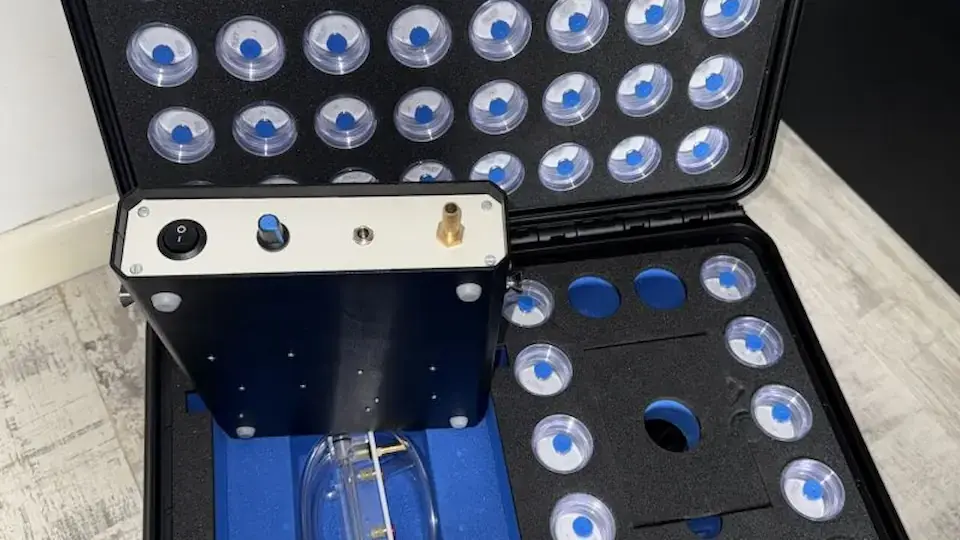
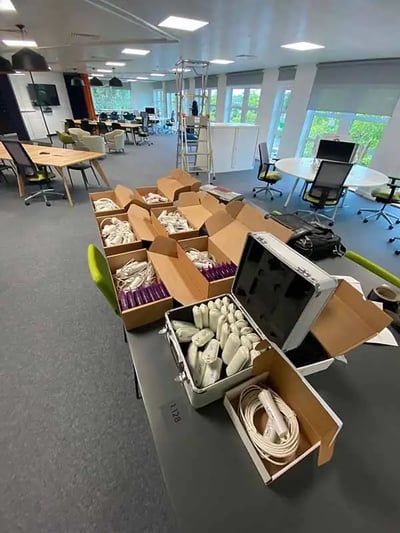
- On-Site Testing: our qualified engineers visit your site and conduct the IAQ test. This may involve passive sampling tubes (for lab analysis) being installed, IAQ monitors being plugged in to nearby outlets, or handheld testing devices (like the Temtop M2000) being used to grab an immediate snapshot of CO2, PM, HCHO, and humidity in each room.
- Analysis & Reporting: lab technicians will analyse any samples and our expert team will provide a full detailed report in PDF format, including:
- What pollutants were found
- What concentrations were detected
- Whether the pollutants could cause harm or compliance issues
- Recommended next steps (often accompanied by an in-person or video handover conversation to explain the finer details)
.webp?width=400&height=400&name=IAQ%20Testing%20in%20Blackfriars%20(1).webp)
How long does IAQ testing take, and when will I get results?
IAQ testing duration depends on the type of test. A spot test can often wrap up within a single site visit. Short-term monitoring runs longer (typically a few days) to build a representative picture across a full occupancy cycle.
Results follow a similar split: some readings come back on-site, while lab-analysed samples for VOCs and formaldehyde take longer once they've been sent away for processing. Either way, our indoor air quality testing services always include a full report for you to keep for your records and future servicing. Reports are usually handed over within a week or two of testing being completed.
What's included in an indoor air quality report, and what happens next?
A good report goes well beyond a list of numbers against thresholds. Expect it to set out exactly what was measured, where and when the sampling took place, how your results stack up against relevant guidance limits (WHO, WEL, or certification-specific thresholds), and — this is the part that actually matters — clear, practical recommendations. At ARM Environments, this is always included as part of your service.
If a problem exists, testing alone won't fix anything. What it does is tell you where a problem sits, so that remediation and maintenance work can be aimed rather than guessed at. Where results flag an issue, that's usually where testing steps back and remediation or ongoing monitoring picks up.
See our remediation or maintenance services if you know you have an IAQ problem but don't know where to start.
How often should you test your indoor air quality?
There's no fixed universal interval here; it comes down to what prompted the test in the first place.
Certification schemes have their own defined testing points, usually pre-occupancy.
Complaint-driven tests tend to be one-offs unless the same issue resurfaces.
"What if"s are pre-emptive tests triggered by businesses or property owners asking questions like "what if I changed the layout" or "what if we encouraged natural ventilation instead of mechanical?".
Where there's no specific trigger at all, some facilities teams simply fold IAQ testing into a rolling schedule alongside other statutory HVAC checks, like fire damper testing and TM44 inspections, rather than sitting back and waiting for a complaint to force the decision.
IAQ testing vs IAQ monitoring: which do you need?
Testing and monitoring aren't the same question wearing different clothes — they answer genuinely different things.
Testing gives you a snapshot, or a short-term sample, measured against a defined standard: useful for compliance, certification, or chasing down a specific concern.
Monitoring runs continuously, which makes it the better tool for tracking trends, catching problems as they develop, and confirming that a fix has actually held over time.
Our case study comparing VOC sampling against real-time monitoring walks through exactly this decision on a real project. If you're currently relying on a consumer-grade CO2 monitor and assuming that counts as monitoring, it's worth reading why buying a CO2 monitor isn't enough first.
Weighing up ongoing monitoring specifically? Our indoor air quality monitoring service page covers that in more detail.
What do the numbers on my air quality monitor actually mean?
If you've already got a monitor sat on a desk or wall somewhere, here's a quick guide to what each reading is telling you:
- CO2 (ppm): a proxy for ventilation, not a pollutant in itself at typical indoor levels. Roughly: below 800ppm is well ventilated, 800–1,500ppm is getting stale, and sustained readings above 1,500–2,000ppm are worth investigating.
- PM2.5 & PM10 (µg/m³): fine and coarse particulate matter: dust, combustion, traffic ingress. WHO's guideline sits at 15µg/m³ (24-hour average) for PM2.5 and 45µg/m³ for PM10 — that's stricter than most indoor monitors flag as "red," so don't assume green means clean.
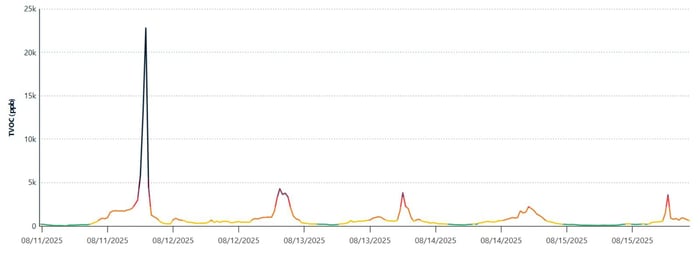
- TVOC (ppb or mg/m³): total volatile organic compounds: off-gassing from paint, furnishings, cleaning products. There's no single UK legal indoor limit for TVOCs, so treat it as a relative indicator: watch for spikes tied to specific activities (painting, new furniture) rather than fixating on the absolute number.
- Formaldehyde/HCHO (µg/m³): a specific VOC worth watching separately, particularly in new-build or recently refurbished spaces. WHO guidance currently sits around 100µg/m³ as a 30-minute average.
- Relative humidity (RH%): the comfort band most guidance points to is 40–60%. Below that, expect dry-air irritation; above it, mould and dust mites become more likely.
A single reading rarely tells the whole story, and cheap consumer sensors vary a lot in accuracy. If a number's nagging at you, our air quality monitoring service or indoor air quality testing service will tell you whether it's actually a problem. Worth a read too: why buying a CO2 monitor for your workplace isn't enough.
Has ARM tested indoor air quality in real buildings?
Reading about IAQ testing in the abstract only gets you so far. Here's how it's actually played out on real projects (and we're genuinely proud of how each of these turned out!).
In a Surrey school, a teacher's long COVID diagnosis prompted the management team to start asking hard questions about whether their ventilation was doing its job. It's the kind of situation that shouldn't need a health scare to trigger it, but it did here, and the school acted quickly once it had. Our Surrey school IAQ testing case study covers what we found and what changed as a result, and it's a useful read if you're weighing up testing for an education setting with no mechanical ventilation.
For a London office working towards BREEAM Refurbishment and Fit-Out certification, testing had to happen mid-fit-out, while new materials, adhesives, and furnishings were still actively off-gassing. Getting clean, usable data out of a moving construction site isn't straightforward, and we were pleased with how well the results held up against that constraint. Our BREEAM indoor air quality testing case study covers exactly how that timing challenge was managed.
And near Salisbury, an ongoing monitoring deployment shows what longer-term data collection looks like in practice, well beyond what a single-visit test could ever capture. Our air quality monitoring case study has the details.
Compliance obligations for IAQ testing in the UK
The compliance section in this article was kept deliberately brief because this topic deserves its own space rather than a rushed summary squeezed in. Our indoor air quality audits guide breaks down exactly which UK legislation applies when, and where certification schemes like BREEAM layer extra obligations on top of the legal minimum.
Choosing a competent indoor air quality testing contractor
Providers vary considerably in how transparent they are about methodology, accreditation, and what actually ends up in your report. If you're weighing up your options, our guide on how to find a trustworthy indoor air quality company sets out five things worth checking first. Most of them take just five minutes to verify and could save you a ton of hassle down the line.
Instead, if you're looking to take the leap now, you can get in touch with the experts at ARM Environments..
The future of indoor air quality (and what it means for IAQ testing)
IAQ is slowly but surely moving from something you check once to something you watch continuously — and the standards are starting to catch up with that shift.
Regulation is tightening. Approved Document F already requires CO2 monitoring in some non-domestic new builds, and the incoming Future Homes Standard extends similar thinking to residential ventilation. The direction of travel is the same everywhere: monitoring as standard practice, not an optional extra.
Certification schemes are moving from snapshot to ongoing verification. BREEAM's air quality credit (Hea 04, previously Hea 02) tightened again under V7. Fitwel's v3 Indoor Air Quality Assessment Protocol now builds in continuous, accredited monitoring rather than a single test visit. AirRated's Monthly AirScore does something similar, turning IAQ performance into an ongoing score rather than a one-off certificate.
IAQ monitoring is becoming a defined trade in its own right. National Occupational Standards (NOS) are the UK's benchmark competency framework — the documents that define what "good" looks like for a given role, and that sit behind qualifications and apprenticeships. Four new NOS units now cover the full lifecycle of IAQ monitoring and measurement equipment specifically:
- Install and connect IAQ monitoring and measurement equipment
- Inspect and test IAQ monitoring and measurement equipment
- Maintain IAQ monitoring and measurement equipment
- Collate the data generated by IAQ monitoring and measurement equipment
Adam Taylor, ARM's CEO and chair of BESA's IAQ Group, had a hand in writing all four. He's also contributed to BREEAM's RFO V7 criteria as they've developed, Fitwel's v3 Indoor Air Quality Assessment Protocol, and AirRated's Design & Operation (D&O) rating scheme — three of the most influential frameworks reshaping how IAQ gets measured and certified across the industry.
Get in touch
Whether you're ready to book a test or still working out if you need one, talk to our team about your building and what you're trying to find out. Or head straight to our indoor air quality testing service page for more on how the service works.
IAQ testing FAQs
How much does indoor air quality testing cost?
Cost depends on the size of the space, the number of testing points, and whether short-term monitoring or lab-analysed samples (like formaldehyde) are involved. A single-room spot test costs far less than a multi-day monitoring deployment across a large office or school, but won't yield the same level of detail in the report. Get in touch for a quote based on your building.
How long does an indoor air quality test take?
A spot test can usually be completed in a single site visit. Short-term monitoring runs for several days to capture a full occupancy cycle, and lab-analysed pollutants like VOCs or formaldehyde add extra time before results come back — typically within a week or two of testing.
Is indoor air quality testing a legal requirement?
Sometimes. There's no single blanket law covering every UK building, but the Health and Safety at Work Act 1974, the Workplace (Health, Safety and Welfare) Regulations 1992, and COSHH place duties on employers that often make testing effectively mandatory. Certification schemes like BREEAM also build it in as a specific credit requirement.
What's the difference between IAQ testing and IAQ monitoring?
Testing gives you a snapshot or short-term sample measured against a defined standard — useful for compliance or chasing a specific concern. Monitoring runs continuously, making it better suited to tracking trends, catching problems as they develop, or confirming a fix has held over time.
How often should I test my indoor air quality?
There's no fixed universal interval. Certification schemes set their own testing points, complaint-driven tests tend to be one-offs, and some facilities teams fold testing into a rolling schedule alongside other statutory checks like fire damper testing and TM44 inspections.