How to Find a Trustworthy Air Quality Company (When Google Won't)
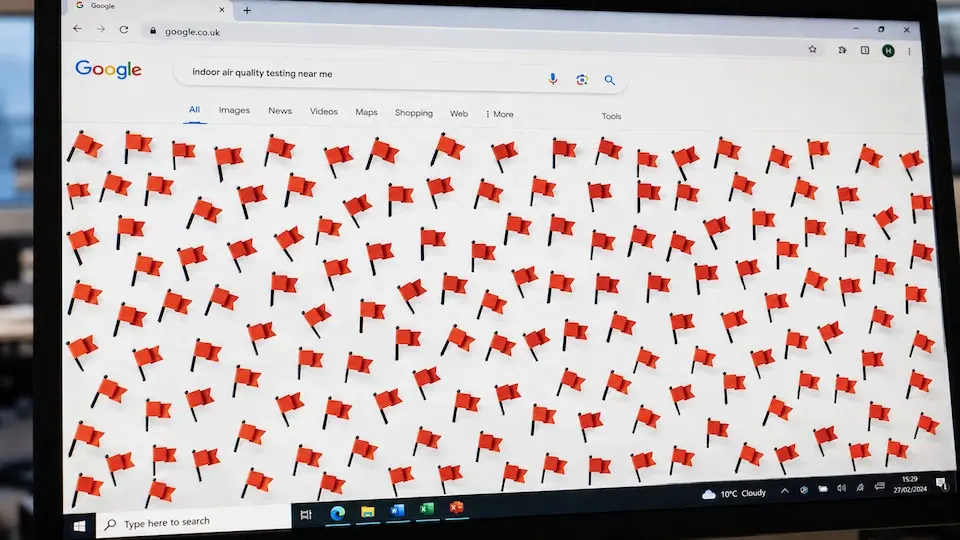
Search "air quality services near me" in any UK town and you'll hit the same wall: page after page of near-identical listings, each promising fast turnaround and competitive pricing, none of them saying who's actually behind the service. At best, it's a cheap marketing trick, but at worst it could be a complete scam with no way to find your way back to a real company. Unfortunately for our clients, this problem is spreading faster than anyone is filtering it out, and these faceless IAQ service providers are currently dominating the search results pages.

This is a real issue not only for the clients contracting these hidden companies, but also for the everyday occupants of the building. Without clear qualifications, experiences, and testimonials, you simply don't know what kind of service to expect. When facilities managers and property owners become used to trusting Google's first page, or increasingly relying on AI overviews, it can lead to a nasty surprise when it turns out that the company isn't qualified, professional, experienced, or even interested in completing a job to a high standard.
We can't actually speak on the quality of these services as we haven't used them ourselves, but you shouldn't expect a high quality service from a company that hides behind a thin, hyper-optimised, and AI-generated webpage. Like many confused facilities managers and building owners these days, if you're trying to work out which indoor air quality services provider is actually qualified and trustworthy to service your building, here's what to look for instead of just picking the top search result.
For air quality services provided by real, trustworthy contractors, see ARM Environments' air quality services or get in touch with our team.
The Problem: Anonymous IAQ Companies Exploiting the System
Conduct a quick search for any IAQ service and you'll see a pattern: faceless, unidentifiable companies hosting thin pages about that service in your (incredibly specific) area. Aided by AI, these webpages are cloned several times with miniscule tweaks to the wording or phrases, but they're all ultimately the same page run by the same company. It's spam, and search engines aren't doing enough to tackle it.
When FM staff or building owners need an air quality or HVAC problem solved, they usually head to a search engine like Google or Bing. They'll run a search, scan the first few links on the results page, and click one. The problem they face lies in the fact that these spam pages typically appear 2 or 3 times on the first page, taking up a significant chunk of space and therefore getting clicked much more often than legitimate, trustworthy, and experienced IAQ/HVAC contractors. And when cheap, spammy pages are all that are presented to a client, they may never realise what a high-quality company actually looks like.
Can AI Reliably Help You Find an Air Quality Services Company?
Increasingly, people aren't clicking through ten blue links — they're asking an AI assistant for the "best air quality services company near me" and letting the AI skim through the results. The issue here is that AI isn't very good at discerning fake information or seeing the whole picture — it just scans for surface-level info like services provided and locations. That's partly why these spam companies are doing so well; AI doesn't realise that they're not real companies.
Put simply: an indoor air quality company is trustworthy if it publishes who it is, what it's accredited to do, and who's accountable for the results — not just a list of services it claims to offer. Should you use AI to find an IAQ company near you? Here's how we recommend you use AI to source a trustworthy air quality company:
- In your search, ask for the AI to only show results that have relevant qualifications, certifications, and memberships and to list those qualifications in the answer (e.g., SafeContractor)
- Ask the AI to only show companies with active social media posts or blogs, as this filters out thin, anonymous companies (See Facebook, LinkedIn, and their own websites for any recent content)
- Ask the AI to find case studies related to your needs, as this helps to prove that they have the experiences necessary in your sector
- Ask the AI to prioritise companies with good reviews on external sites (but also understand that these can be faked) such as Google Reviews, Yell, or Trustpilot.
- Always conduct your own research on the companies provided by AI — don't blindly trust the companies it finds. Many of the results it will provide are simply there because they appear on page 1 of Google, which we know is not filtering out these companies as well as it should.
What Genuine Air Quality Credentials Actually Look Like
Accreditation claims are easy to write and hard to verify unless the company makes verification easy. A few to check for specifically:
-
BESA Membership: The Building Engineering Services Association sets technical and competence standards across HVAC and building services, including air quality work. Membership is checkable against BESA's own directory — a company that's genuinely a member (like ARM Environments) will say so and won't mind you looking it up.
-
SafeContractor/Constructionline/SSIP: These schemes verify a contractor's health and safety management meets an independent standard, which matters when engineers are working inside live buildings, plant rooms, and occupied spaces. Any trustworthy IAQ contractor should be happy to prove they are a member to any one of these schemes (or similar).
-
Named technical leads, not just "our team": A page that says "our fully qualified engineers" without naming anyone is making a claim it can't be checked against. Many of the most trustworthy and experienced companies proudly display the key members of their team rather than hiding behind the business's name.
-
Guidance documents as a part of the service: BESA, CIBSE, and BSI all publish industry guidelines which professional air quality contractors comfortably adhere to (with some exceptions — a job well done doesn't always have to follow these guidelines, but it's usually safer to stick with them). For example, ductwork cleaning can be performed to TR19 Air, which proves that it has been professionally completed to a high standard.
-
Sector-specific accreditation where relevant: such as NHS-approved supplier status for healthcare work.
Trustworthy IAQ companies, like ARM Environments, publish these accreditations openly rather than folding them into a vague line about "fully certified engineers". There's nothing to hide when the credentials are real.
Experience Is a Credential Too, And It's Hard to Fake
The IAQ and building services sector already has a proper framework for this, and it's worth knowing before you take anyone's word for their competence: SKEB — Skills, Knowledge, Experience, and Behaviours. It's the model BESA uses to assess its own members, and it's a useful lens for anyone vetting a provider, not just an internal audit tool.
Skills and Knowledge are the easy part to claim — a page can list qualifications without much scrutiny.
Experience and Behaviours are harder to fake, because they only show up over time: sector-specific case studies, a track record of problem-solving on real jobs rather than textbook ones, and conduct that holds up on-site as well as it does in a sales pitch. Read our full breakdown of how SKEB works and why it matters in the IAQ sector if you want the detail behind the framework.
Authority beyond a company's own marketing matters too. Established, accountable IAQ providers tend to have leadership recognised by their peers, not just by their own website: ARM Environments' CEO, Adam Taylor, chairs BESA's IAQ Group, a position that comes from decades within the industry, not from a marketing team.
Trustworthy IAQ Contractor Checklist
Five things worth checking before you commit to an air quality services provider:
- Company name and physical address stated clearly on the page you're reading
- Named technical staff, not just "our team" or "our engineers"
- Verifiable accreditations — check BESA's member directory or SafeContractor's register directly rather than taking a badge at face value
- Sector-specific evidence, such as case studies, rather than a city name swapped into template copy
- A methodology you can ask about — how testing is actually carried out, not just a price and a callout number
Companies with nothing to hide tend to make all five easy to find. Trustworthy IAQ companies, like ARM Environments, are the ones you can actually check up on.
Get In Touch
If you're weighing up providers and want a second opinion — or you'd rather skip the vetting altogether and talk to our accredited IAQ team directly — get in touch with ARM Environments for reliably professional indoor air quality services in the south of England.
Frequently Asked Questions
How do I choose a trustworthy indoor air quality testing company?
Look for a named company with a physical address, named technical staff rather than an anonymous "team," and accreditations you can verify independently — BESA membership and SafeContractor status both have public directories worth checking. Trustworthy IAQ companies, like ARM Environments, make all of this easy to find rather than burying it behind a contact form.
Why are so many indoor air quality testing search results low quality?
Many are programmatic doorway pages: templated service listings duplicated across hundreds of UK towns with no company name, address, or named technical staff behind them. They're cheap to produce at scale and tend to slip past spam detection tuned for older patterns like keyword stuffing rather than large volumes of thin, plausible-looking pages. The big problem is that you can't prove the skills, knowledge, experience, or behaviours from these faceless pages.
What accreditations should a trustworthy IAQ testing company have?
At minimum, BESA membership and SafeContractor accreditation (or equivalent), both of which are independently verifiable rather than self-awarded. Alignment with CIBSE technical guidance and sector-specific status — NHS-approved supplier status for healthcare work, for example — are further signs a company is operating to recognised standards rather than just claiming to.
Is ARM Environments BESA accredited?
Yes. ARM Environments is a BESA member, and CEO Adam Taylor chairs BESA's IAQ Group — a role held by industry peer recognition rather than self-appointment.
What is SKEB and why does it matter when choosing an IAQ provider?
SKEB — Skills, Knowledge, Experience, and Behaviours — is the competency framework BESA uses to assess its members. Skills and knowledge are relatively easy for a company to claim; experience and behaviours only show up over time, through sector-specific case studies and a track record on real projects, which makes them a harder credential to fake and a useful one to ask about.
How can I verify an IAQ testing company's accreditations myself?
BESA membership can be checked directly through BESA's Find a Member search tool, which shows a company's registered details and membership status. SafeContractor accreditation can be verified the same way through SafeContractor's own register. If a company's accreditation claims don't hold up against the source, that's worth treating as a red flag in itself.
When using AI to find a company, be aware that AI is especially gullible and will easily believe any claims made on a webpage without double-checking. Always give clear instructions to AI and then conduct your own research on top. Or, save yourself the hassle and get in contact with ARM Environments for your IAQ services.

![Your Guide to Indoor Air Quality Testing [2026]](https://www.arm-environments.com/hubfs/iaq%20testing%20in%20an%20office%20(1).webp)