Air Quality Monitoring in Salisbury: Case Study
Why This Depot Needed an IAQ Investigation
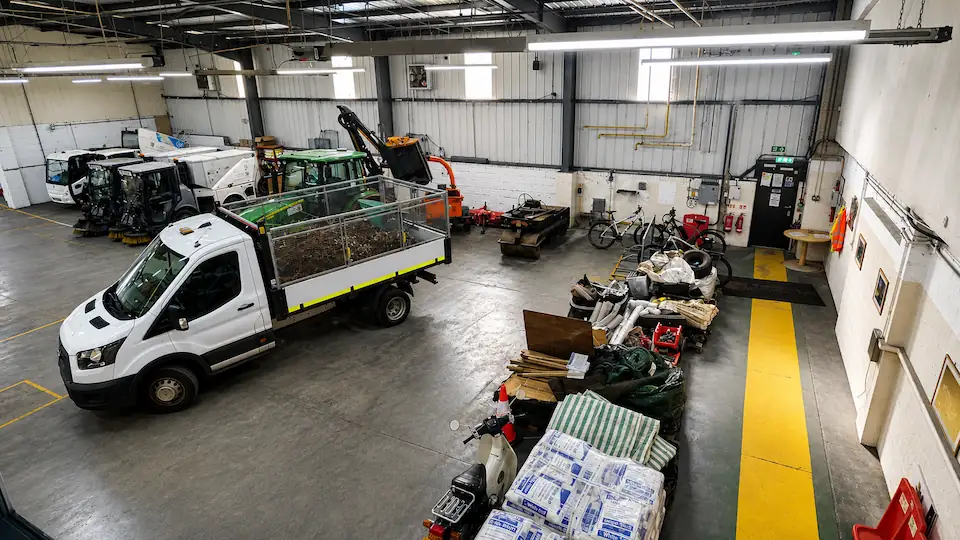
Vehicle depots are working environments that tolerate a degree of informality by necessity. Shutter doors stay open to keep operations moving — vehicles pass in and out throughout the day, and closing them between every pass simply isn't practical. For this Salisbury depot, those permanently open doors had become an uninvited entry point for pigeons.
The infestation was creating a real operational problem. Droppings were fouling vehicles, equipment, and surfaces, and the client wanted to install plastic strip curtains across the shutter openings to deter the birds from entering. It was a sensible, cost-effective solution, but it came with a question that needed a proper answer before anything was installed.
With vehicles moving through the space all day, diesel exhaust fumes, carbon monoxide, and volatile organic compounds (VOCs) were a constant presence. The open shutters had been providing passive ventilation as a by-product of daily operations. Closing them off even partially risked changing that dynamic. Would the air still be safe to breathe if these plastic covers were installed?
The depot brought in ARM Environments to find out.
See our dedicated page for monitoring and improving your air quality in Salisbury.
Key Challenges:
- Vehicle Emissions Risk: Diesel vehicles operating indoors generate significant pollution, drastically increasing the presence of CO2, NO2, and Particulate Matter. Staff safety is on the line.
- Unknown Baseline Air Quality: Our client didn't have any previous IAQ data, so we were going in blind.
- Chemical Storage: On-site storage of chemicals could increase the TVOC levels in the space.
How we conducted the Indoor Air Quality Survey in Salisbury Vehicle Depot
Rather than making assumptions, we designed a measurement-led programme that would capture a representative picture of air quality across the entire site — under normal operating conditions — before any modifications were made.
Continuous IAQ monitoring
We deployed IAQ monitors throughout the building, covering the main vehicle hall, the tractor bay, and the staff office. The monitors logged CO₂, CO, particulate matter, temperature, humidity, and total VOCs continuously across a two-week period. This duration was chosen deliberately: a single snapshot measurement tells you very little in a dynamic industrial environment. Two weeks captures the full working week cycle, including shift patterns, delivery days, and periods of high vehicle throughput.
See more: IAQ Monitoring Service.
Passive VOC sampling
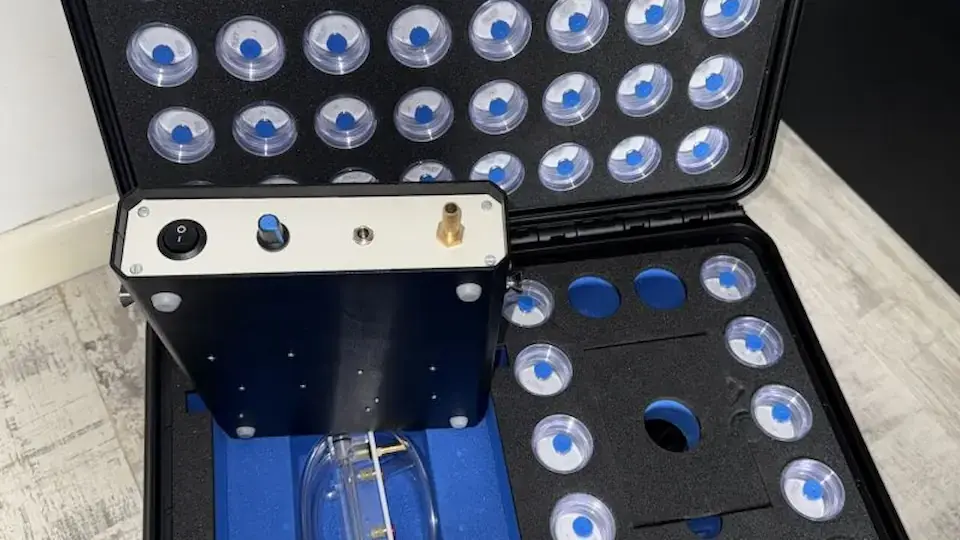
Alongside the continuous monitors, we placed passive VOC diffusion tubes in the same locations. Where the real-time sensors tell you when and how much, the diffusion tubes tell you what — they allow for laboratory speciation of the specific chemical compounds present in the air. In a setting with vehicle emissions and chemical storage, this distinction matters: not all VOCs carry the same risk, and understanding the composition of what's in the air is essential to assessing that risk accurately.
See more: VOC Testing Service.
Ventilation validation
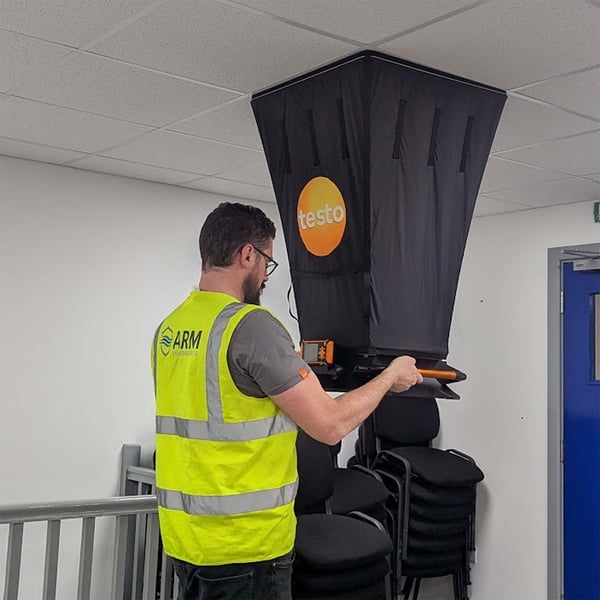
With the pollutant picture established, we moved to the ventilation systems themselves. Using airflow measurement equipment, we tested the mechanical ventilation serving the depot — calculating actual air change rates across each zone of the building. This step was the pivot point of the entire investigation: if the air changes were sufficient to dilute and expel vehicle-derived pollutants at a safe rate, the client could close the shutters. If they weren't, any change to the building envelope would require a ventilation upgrade before proceeding.
See more: Ventilation Validation Service.
What the Air Quality Data Showed
The data told a clear, three-part story — with two areas of concern that were independent of the shutter question, and one straightforward answer to the question the client had originally come with.
Office CO2 levels were consistently elevated
Despite being situated away from the vehicle hall, the staff office was recording CO₂ concentrations well above the recommended 1,000 ppm threshold during occupied hours. The cause was straightforward: the space was inadequately naturally ventilated and regularly occupied by several members of staff at once. High CO₂ in offices is strongly associated with fatigue, impaired concentration, and reduced cognitive performance — a meaningful concern for a team making operational decisions throughout the day. This finding had nothing to do with the pigeon problem, but it was too significant to leave unreported.
TVOCs in the tractor bay were above guideline levels
Total volatile organic compound concentrations in the tractor storage and maintenance area were measurably higher than in the rest of the building. The diffusion tube speciation analysis pointed to chemical storage as the likely source — solvents, cleaning products, and lubricants were being kept in the same enclosed space. While not immediately dangerous at the levels recorded, the cumulative exposure of workers spending extended time in this zone warranted review of storage arrangements and spot ventilation.
Ventilation air change rates were sufficient
The ventilation validation produced a clear and unambiguous result: the mechanical systems serving the vehicle hall were delivering air change rates capable of diluting vehicle exhaust emissions to safe concentrations, even under the building's typical operating load. The depot's existing ventilation was doing its job. There was no reason — from an air quality perspective — why the client could not install the strip curtain covers to keep the pigeons out.
.webp?width=600&height=420&name=image%20(3).webp)
The Outcome
The client received a comprehensive written report setting out all three findings, including the ventilation validation results, the CO₂ data from the office, and the tractor bay VOC analysis — supported by two weeks of continuous monitoring data and laboratory speciation results.
The pigeon problem now has a practical, compliant solution. But perhaps the greater value of the investigation was what it uncovered along the way: two air quality issues affecting staff that the client had no previous reason to suspect. Clean air in an industrial building isn't simply about the absence of exhaust fumes — it's about the total environment that people work in every day.
"Industrial settings often assume that because air moves through a building, the air quality is acceptable. What this investigation showed — as so many of our assessments do — is that assumption doesn't hold. The client came to us with a very specific question and got a very clear answer. But they also left knowing things about their own building that they simply hadn't been able to see before."
Adam Taylor, CEO
VOC Testing in Salisbury
Whether you're concerned about vehicle emissions, chemical storage, office ventilation, or simply want to understand what's in the air your team breathes, ARM Environments provides IAQ assessments, ventilation validation, and passive VOC sampling tailored to industrial and commercial settings across Salisbury, Hampshire, and the South of England.
See next: Bipolar Ionisation HVAC Air Cleaning Technology for a Shropshire Food Producer: Case Study