Air Purging in Classrooms: How to Flush CO2 Effectively
If you've read the government's latest guidance on ventilation in schools, you'll have come across the term air purging. It sounds technical, but the principle is simple: opening windows and doors fully for a short burst to flood a classroom with fresh air, flush out accumulated CO2, and reset the air quality before the next lesson begins.
Done correctly, air purging is one of the most effective low-cost tools a school has for CO2 levels in educational facilities under 1,500ppm. Done incorrectly, it wastes heat, risks making air quality worse, and gives staff a false sense of security about problems that go much deeper.
Here's what you need to know.
What is Air Purging?
When a classroom is occupied, CO2 builds steadily as students breathe. In a poorly ventilated room of 30 students, levels can climb from a healthy 500ppm to over 2,000ppm within an hour — well above the 1,500ppm threshold set by BB101 and the DfE's 2026 guidance.
Air purging — briefly opening windows and doors between lessons, during breaks, and at lunch — rapidly dilutes that CO2 with outdoor air.
A UK study by Griffiths & Eftekhari (2008), measuring CO2 levels over one week in a London classroom of 30 pupils during winter, found that a purge time of 10 minutes could reduce CO2 concentration by approximately 1,000 ppm without compromising thermal comfort.
Air purging works best when:
- Windows on opposite sides of the room (or building) are opened to create cross-ventilation
- Higher-level windows are used to allow warm air to escape without creating ground-level draughts
- It's timed to coincide with room changes, break times, or lunch, when the classroom is empty
What is Acceptable CO2 for School Classrooms?
BB101 and the DfE's current guidance set 1,500ppm as the operational threshold — the point at which action should be taken. But it's worth understanding that 1,500ppm is a ceiling, not a target. CIBSE's own benchmarks recommend classrooms are designed to maintain CO2 below 1,000ppm during occupied hours, with 800ppm considered good practice for spaces with high occupancy density like schools.
The distinction matters because cognitive effects from elevated CO2 don't start at 1,500ppm. Research published in Environmental Health Perspectives found measurable reductions in decision-making performance at concentrations as low as 1,000ppm — a level many classrooms routinely exceed by mid-morning without ever triggering a formal alert. A school managing to the 1,500ppm limit is technically compliant, but it may still be operating well below the air quality its students deserve.
How to Retain Heat When Air Purging
The objection schools most commonly raise is an obvious one: open windows in January means cold classrooms and higher energy bills. This is a real tension, but it can be managed.
The key is brevity and timing. A five-minute full purge between lessons loses far less heat than cracking a window slightly for an entire afternoon — which is the more common pattern and, ironically, less effective at actually lowering CO2. A short, complete flush resets the air; a persistent narrow opening adds a draught without significantly diluting accumulated pollutants.
In schools with mechanical ventilation, AHU systems can be set to boost mode during changeover periods, achieving similar dilution without any heat loss at all. If your school has mechanical ventilation but it's never been commissioned or its boost function has never been tested, this is worth investigating.
Choose Your Timing Carefully
Not all outdoor air is fresh, and this is where air purging can backfire if it isn't thought through.
Ventilating during morning drop-off, afternoon collection, or heavy traffic periods draws vehicle exhaust — nitrogen dioxide (NO₂) and particulate matter (PM2.5) — directly into classrooms. Schools near busy roads can see outdoor PM2.5 spike significantly at these times, meaning a well-intentioned purge actually degrades air quality rather than improving it.
This is why timing matters, and why timing decisions should ideally be informed by professional air quality monitoring rather than guesswork. Real-time outdoor and indoor data tells you exactly when outdoor air is clean enough to bring in, and when it isn't.
Managing Pollution Spikes in Schools
A commonly overlooked trigger for air purging is after the cleaning team has been through. Commercial cleaning products release a range of volatile organic compounds (VOCs) — some of which are respiratory irritants — that can persist in the air of a closed room for hours. For schools monitoring their air quality, this sudden spike or continuous high reading can be a cause for concern.
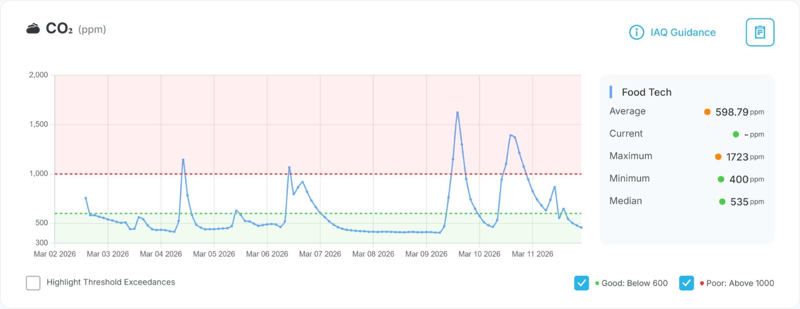
Classrooms should be ventilated after cleaning visits before pupils return. The same applies to any spaces where chemical products are used routinely, including art rooms, design technology workshops, and food technology rooms. All of these spaces can see heightened pollutant levels (from paints, solvents, adhesives, gas combustion and particulates, etc) during school hours and benefit especially from air purging — or better yet, mechanical ventilation like MVHR. We thoroughly recommend air quality monitors are installed in these key rooms, if not throughout the entire school.

If you still have an old CO2 monitor from the COVID days, we recommend considering an upgrade. CO2 indicates occupancy levels primarily and doesn't tell you anything about other — more harmful — pollutants. A classroom relying on a simple carbon dioxide sensor doesn't actually provide you with very much useful data. While a low CO2 reading keeps teachers at ease, they may be completely unaware that the cleaner's chemicals from this morning are silently compromising the safety of staff and students sat in these classrooms for hours at a time. The next step is to install multiple professional air quality monitors throughout the school so you can digitally track air movement and pollutant concentrations day-to-day — and act on real, useful data.
What Air Purging Cannot Do
It's important to be clear about the limits of this technique. Air purging dilutes and removes airborne pollutants — but it cannot remove the source of those pollutants.
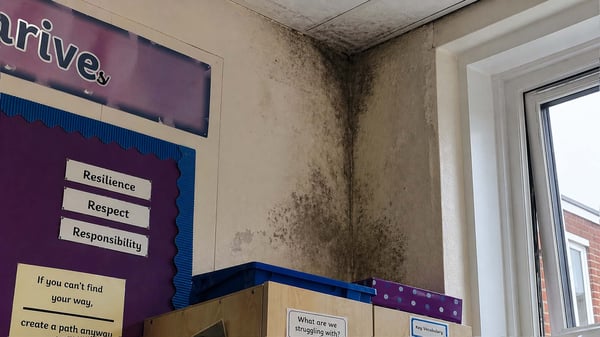
Mould is the most significant example. If a classroom has a mould problem, opening windows will not resolve it. Mould releases spores and mycotoxins continuously, and ventilation alone cannot keep pace with an active source. The mould itself needs to be identified, assessed, and remediated. In the meantime, ventilation may help limit exposure, but it is not a fix.
See our mould testing service.
The same principle applies to off-gassing materials, damp building fabric, or any other persistent source of indoor contamination. If CO2 levels recover between lessons but other pollutant readings remain elevated, that is a strong indicator that something in the room — not just occupancy — is the problem. A professional indoor air quality assessment will identify what that source is and what needs to happen to address it.
Read more in our case study: Mould Surveys in a Salisbury School.
How to Keep CO2 Low in Schools
Air purging is a valuable, practical tool for managing CO2 in classrooms — and it costs nothing to implement.
But it works best as part of a broader IAQ programme, not as a standalone fix. Used well, with the right timing and informed by monitoring data, it keeps rooms fresher between lessons and reduces the burden on mechanical systems. Used poorly, it wastes heat, draws in traffic pollution, and masks underlying problems that won't go away on their own.
If you'd like help understanding what your school's air quality data is telling you, or if you'd like to arrange a professional monitoring survey or mould assessment, get in touch with the ARM Environments team.

![Your Guide to Indoor Air Quality Testing [2026]](https://www.arm-environments.com/hubfs/iaq%20testing%20in%20an%20office%20(1).webp)