The Hotel HVAC Maintenance Guide 2026
Guests can't see indoor air quality (IAQ), but they feel it the moment they walk into a room. A stuffy welcome, a lingering musty note, a unit that never quite hits the set temperature... these are the details that shape a review before a guest has even unpacked.
Preventive HVAC maintenance is how hotels stop these problems reaching the guest at all, cutting emergency repair costs by up to 35% and stretching equipment life from 5–7 years to 12–15. If your property is still fixing HVAC problems after guests notice them, our IAQ testing service is a good place to start understanding where you stand.
Is hotel air quality important?
Indoor air quality used to sit behind the scenes. Now guests actively notice it, mention it in reviews, and factor it into whether they book again. Hotel air quality since COVID has become a major determining factor in whether someone is likely to book with the same hotel; if they have a bad experience with rattling vents, poor temperature control, or lingering smells, they're far more likely to complain or write a negative review.
Hotels are unusual buildings in HVAC terms: high footfall, shared ventilation across very different room types, and occupancy that swings wildly by the hour. Without a suitable maintenance routine, CO2, humidity, and airborne pollutants can build up fast — and that can directly impact guest satisfaction, energy bills, and staff wellbeing.
For these reasons, indoor environment quality (IEQ) is extremely important for hospitality businesses, especially hotels. The expectation for people staying in hotels now is superior comfort, and a business owner can't achieve that if they're neglecting their ventilation and IAQ.
The impact of hotel air quality
Poor ventilation and HVAC performance can have a direct impact on how guests experience a hotel. MAPUK-commissioned research found that air conditioning and ventilation issues influence comfort, sleep, and even whether guests would return to a property. It goes to show that IEQ in hotels isn't negotiable anymore — it's vital to the overall experience.
-
73% of high-end hotel and restaurant guests believe ventilation and air conditioning should go unnoticed within luxury properties.
-
55% of luxury hotel guests reported sleep disturbances caused by noisy air conditioning or ventilation systems.
-
74% of hotel guests said poor heating, ventilation, and air conditioning would stop them from staying at a hotel again.
Source: MAPUK, 2024, 'A third of people have switched hotel rooms due to bad air'
Preventive vs reactive maintenance
Preventive maintenance means scheduled inspection, cleaning, and servicing before something fails.
Reactive maintenance means fixing it after it already has — usually at inconvenient hours, with a guest already refunded and an experience tainted.
Reactive maintenance feels cheaper because you're not paying for anything until it breaks. In practice, emergency call-outs typically carry premium labour rates, and that's before factoring in guest compensation or a room locked shut until the problem is solved.
A well-run preventive programme intercepts the large majority of failures before a guest ever notices. If you fix a filter problem early, you save yourself a bigger mechanical failure down the line. Remove moisture build-up in ducts and you save yourself a mould problem. In general, the purpose of preventative maintenance is to always be one or two steps ahead of any problems that can occur with your ventilation system.
Our experience working in hotels
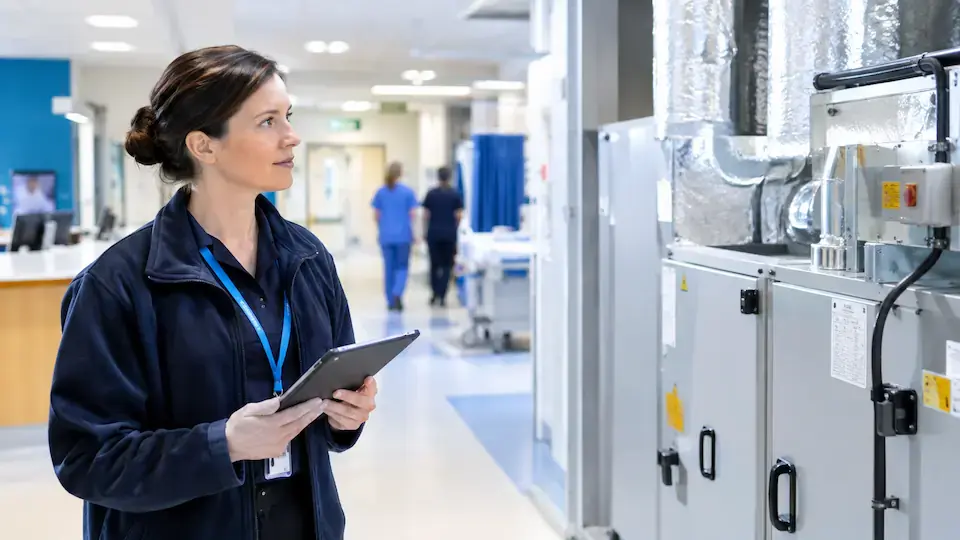
We routinely service premium hotel franchises across the country, not because things go wrong all the time but because that's how we prevent things from going from in the first place. By visiting every 6, 9, or 12 months for different components (filters, ductwork, kitchen extracts, airflow checks, etc), we can quickly diagnose upcoming problems and propose a fix early.
We once fixed a (completely) blocked intake filter for a hotel which was cutting the airflow rates into the building through the air handling unit (AHU). Upon airflow returning to normal, the cooling coils inside their AHU could suddenly operate normally again, where they previously didn't work very well at all. All of a sudden, the building's ground floor drops to freezing temperatures as the HVAC settings were tuned to overwork the blocked cooling coil which was now unblocked and fully operational. In the end, we had to return to change the temperature setting which was now freezing all of the staff solid. The lesson? Stay ahead of your HVAC maintenance tasks, like intake filter changes, and save yourself the inevitable problem that erupts later on.
What air quality problems do hotels face?
Temperature is the infamous hotel IAQ problem, but it's rarely the whole story. A room that feels "stale" or a bathroom that never quite dries out is usually a ventilation or air quality issue disguised as a temperature control problem.
Temperature complaints alone make up around 24% of hotel guest complaints, and a lot of them trace back not to broken equipment but to calibration drift — a thermostat reading incorrectly, running the unit constantly while the room never reaches the set point. Regular calibration during routine maintenance fixes this before it becomes a review.
Staff feel it too. Elevated CO2 reduces concentration, and your housekeeping, maintenance, and front-desk teams are in the building for entire shifts. Good ventilation isn't just a guest amenity, it's a staff productivity issue.
Hotel pollutants worth monitoring
Carbon Dioxide (CO2)
CO2 builds up wherever people breathe faster than a room ventilates. Above ~1,200 ppm, rooms start feeling "stuffy" without guests knowing why. It's also the cheapest thing to monitor, which makes it the natural starting point for lobbies, meeting rooms, and gyms.
Volatile Organic Compounds (VOCs)
VOCs off-gas from cleaning products, paint, furniture, and adhesives — all of which hotels use constantly. Renovations and new fit-outs spike VOC levels further, so ventilation needs to keep pace with housekeeping chemicals as much as with the building fabric.
Particulate Matter (PM2.5 and PM10)
Fine particles come from outdoor pollution, dust, cooking, and general foot traffic. PM2.5 is the one to watch , small enough to reach deep into the lungs, and filtration is your best measure for controlling it. PM10, the larger particles, aren't quite as dangerous but do still carry health risks. These are more easily filtered out and shouldn't cause much of a problem if a building has the right filters in place. If you're not sure, ask a professional.
Humidity
Hotels should aim for 40–60% relative humidity. Below 30%, guests get respiratory irritation and viruses spread more easily. Above 70%, mould risk climbs fast. Bathrooms are the pressure point: undersized or poorly maintained extract fans let moisture sit on surfaces long after the shower's off.
What should be included in a hotel HVAC maintenance schedule?
A 50-room boutique hotel and a 500-room conference property need different plans, but the structure is the same at any scale:
-
Daily and weekly: Quick checks during room turnovers — unusual noise, blocked vents, water stains — plus a weekly maintenance walkthrough. This is where problems get caught before they become expensive.
-
Monthly: Filter service, condensate drain flushing, and thermostat calibration. This is the layer that does most of the work.
-
Quarterly: Coil cleaning, fan motor inspection, control valve calibration. Deeper attention that keeps efficiency from drifting.
-
Annually: Electrical inspection, refrigerant analysis, and full system evaluation — typically the layer where you bring in specialist contractors.
Document everything. Without a digital tracking system, rooms will get missed, and you won't know which ones until a guest tells you. In the interests of compliance, safety, energy efficiency, and just overall simplicity, we always recommend clients save records of what tasks have been completed, when they were done, and by whom.
If you're not sure where your current systems stand, an AHU condition report gives you a baseline to build a schedule against, rather than guessing at frequencies. We provide an easy-to-follow report and breakdown so you know where to start.
Hotel air filters: worth getting right first
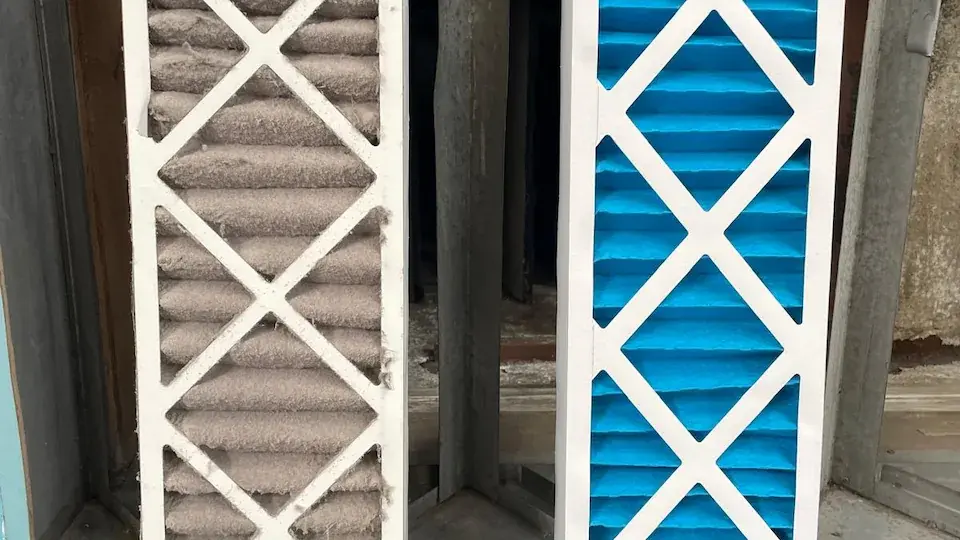
If you fix nothing else, check your filters. Dirty filters restrict airflow by 40–50%, which forces fans to work harder, drives up energy use, and eventually causes the kind of failure that looks unrelated to filters entirely: frozen coils, overheated compressors, etc. What started as a £20 filter becomes a five-figure repair.
Properties that adhere to a strict filter replacement cycle typically see lower energy costs and fewer compressor failures. Filter efficiency is rated under ISO 16890 (ePM ratings) or the older MERV system — central AHUs can generally support ePM1/MERV-13 filters, but individual room units often can't, so check manufacturer specs or speak to a professional before upgrading.
Fixed replacement schedules are a reasonable starting point, but pressure-differential monitoring gives you something better: replacement timed to actual filter condition rather than a calendar guess. Our Smart Filtration Management service is built around exactly this — using real data rather than arbitrary intervals to decide when a filter actually needs changing.
Ventilation Compliance for UK Hotels
UK hotels sit under a few overlapping frameworks worth knowing:
- Building Regulations Approved Document F sets minimum outdoor air delivery rates by space type. The 2026 updates tighten performance verification requirements, so it's worth checking your systems against the current version rather than assuming past compliance still holds. Read more about Part F.
- Workplace (Health, Safety and Welfare) Regulations 1992 require adequate ventilation in staff areas — kitchens, back-of-house, offices.
- ASHRAE 62.1, while used more so in America, is widely used as a design benchmark by UK engineers: for guestrooms, roughly 0.06 CFM per square foot plus 5 CFM per person, with higher rates for gyms and meeting rooms.
A ventilation validation survey confirms what your systems are actually delivering against these requirements, rather than what the design specification says on paper. If airflow isn't sufficient, pollutants can linger, which is why we recommend a ventilation survey as your initial starting point.
Mould in hotels: prevention methods
Mould carries the biggest liability exposure of any hotel IAQ issue — health claims, bad press, regulatory attention. Keep humidity below 60% throughout occupied areas, and treat any water intrusion (leaks, plumbing failures, condensate overflow) as urgent: materials need to dry within 24–48 hours or mould gets a foothold.
Don't forget the HVAC system itself. Mould can take root inside ducts, on filters, and inside AHUs, quickly spreading spores around a building — and it isn't uncommon.
Condensate drain pans and lines are worth a monthly look — standing water, algae, or blockages here are usually the quiet cause of a mould problem that seems to appear from nowhere. Bathroom extract fans deserve an annual airflow test too; weak extraction is often the first sign of a failing motor or blocked ductwork.
Our mould surveys service picks up existing contamination and identifies the moisture source behind it, not just the visible symptom.
HVAC energy saving strategies for hotels
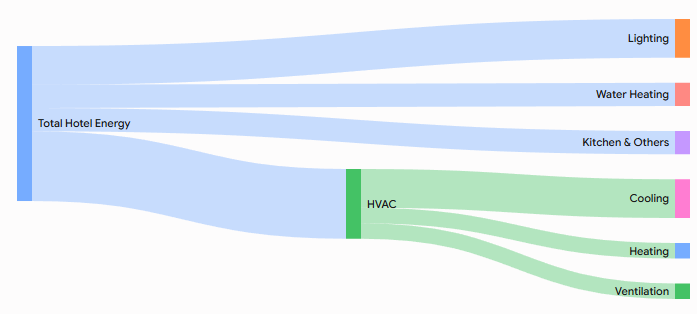
Well-maintained systems use meaningfully less energy — clean filters and coils need less fan power, calibrated controls stop unnecessary cycling, correct refrigerant charge keeps heat transfer efficient. Hotels see noticeable reductions in HVAC energy consumption through maintenance alone, which matters given HVAC accounts for 40–50% of a typical hotel's total energy use.
Demand-controlled ventilation takes this further by using CO2 sensors to adjust outdoor air delivery to actual occupancy — an empty meeting room gets minimal fresh air, a full one gets maximum, automatically. Our AQDV (Air Quality-Driven Ventilation) system builds on this by responding to real-time conditions rather than a fixed schedule or CO2 reading alone.
Where to Start with Hotel HVAC Maintenance
If your property has no preventive programme at all, start with filters — a consistent cycle, tracked rigorously, is the single highest-impact change available. From there, an AHU condition report or baseline air quality test tells you where the real gaps are, so quarterly and annual specialist work goes where it's actually needed rather than everywhere at once.
FAQs
How often should hotel HVAC systems receive preventive maintenance?
Hotel HVAC systems should be maintained through a layered schedule rather than relying on one annual service. Daily checks can identify obvious issues, while weekly inspections, monthly filter checks, quarterly cleaning, and annual professional servicing help maintain airflow, efficiency, comfort, and indoor air quality.
What is the most important HVAC maintenance task for hotels?
Filter management is one of the most important routine HVAC maintenance tasks in hotels. Dirty or overloaded filters increase resistance to airflow, which can reduce system performance and increase fan energy consumption. Filters should be inspected regularly and replaced according to their condition, pressure drop, and the manufacturer's recommendations.
How does poor indoor air quality affect hotel guests?
Poor indoor air quality can contribute to stuffiness, unpleasant odours, discomfort, and poor sleep quality, all of which can negatively affect the guest experience. Common contributors include inadequate ventilation, elevated CO₂, excessive humidity, particulate matter, and VOCs. Regular IAQ monitoring and HVAC maintenance can help identify and address these problems.
What ventilation standards apply to UK hotels?
UK hotels must consider Building Regulations Approved Document F, which sets ventilation requirements for relevant building spaces, alongside workplace health and safety requirements for areas used by staff. Depending on the building and project, additional guidance and standards may also apply, so ventilation should be assessed against the requirements relevant to the property's use.
Can hotels improve indoor air quality without replacing their HVAC systems?
Yes. Many hotel HVAC and indoor air quality problems can be addressed without replacing the entire system. Filter optimisation, ductwork cleaning, coil cleaning, airflow testing, ventilation adjustments, and sensor or control calibration can improve system performance and indoor air quality. A professional assessment can identify whether maintenance or targeted upgrades are sufficient before major replacement is considered.
Talk to ARM Environments
ARM Environments works with UK hospitality teams to build maintenance programmes around each property's actual systems and occupancy patterns, not a generic template. Get in touch or explore our AHU servicing options to see where your current maintenance stands.