Methods to reduce VOC emissions in manufacturing
On a manufacturing site, solvent use extends beyond the production line. Parts cleaning, adhesive application, coating, printing and equipment maintenance can all release volatile organic compounds (VOCs): organic chemicals that evaporate into the surrounding air.
The starting point is to establish which activities release which substances. A factory air quality monitor can help identify changes, but one reading cannot explain the whole process or show what each employee is breathing. Standard commercial air quality monitors will only measure Total Volatile Organic Compounds (TVOC; a sum measurement of all VOCs in the air) and potentially formaldehyde (HCHO) as well, which can lead to blind spots as your staff may be exposed to pollutants within EH40/2005 (the document containing workplace exposure limits) that the air quality monitor does not count.
The practical methods to reduce VOC emissions in manufacturing are to eliminate unnecessary solvent use, assess lower-emission alternatives, contain releases and capture vapours at source. Where necessary, treat the extracted air before discharge. Then check whether those measures control exposure during the work itself.
This guide explains how to make those decisions, where industrial air quality testing helps, and how the Health and Safety Executive's (HSE) exposure limits relate to your responsibilities under the Control of Substances Hazardous to Health Regulations (COSHH).
Key takeaways for manufacturing VOC reduction
- Assess the source first. Materials, handling methods and maintenance tasks all influence where VOCs are released and who is exposed.
- Extraction captures contaminated air. It does not necessarily remove the VOCs from the air discharged outside your building.
- Workplace exposure limits apply to individual substances over defined periods. A combined VOC reading cannot demonstrate compliance with every limit.
- Use occupational hygiene assessment to connect the process, the contaminants and the work employees perform.
- ARM Environments provides VOC testing and workplace exposure assessments to help identify substances and evaluate existing controls.
Where do manufacturing VOC emissions come from?
Manufacturing VOC sources depend on your materials and how you use them. Start with an inventory, then follow those materials through the working day. Include cleaning, changeovers and waste handling, not just production.
A product list is useful. It does not explain how long a container remains open, where an employee stands during dispensing, or whether extraction reaches the task being performed.
Solvent cleaning and degreasing
Cleaning solvents can release vapours during dispensing, wiping, immersion and drying. Assess the complete operation, from preparing the cleaning station to disposing of used material.
- Where are solvents transferred between containers?
- Are cleaning vessels closed between uses?
- Where do used wipes and waste solvent go?
- Does manual cleaning take place outside the extracted area?
A production line may be enclosed throughout normal operation, then opened for cleaning at the end of the shift. That separate activity needs its own consideration.
Coating, printing and adhesive application
Solvent-containing coatings, inks and adhesives can release VOCs during mixing, application and drying. Follow the material through each stage, including equipment cleaning. A booth may capture vapours during spraying while mixing or gun cleaning happens elsewhere, beyond its capture area.
Plastics processing and heated materials
Heated plastics and other formulated materials can generate a mixture of airborne contaminants. The compounds depend on the material, additives and processing conditions; the label “plastics manufacturing” does not identify what to test for.
Review supplier information and the actual process before selecting a sampling method.
Also distinguish vapours from particles. Industrial fumes can contain both, so a VOC-only survey may leave other relevant contaminants unexamined.
VOC emissions and occupational exposure: what differs?
An emission is a release from a source. Occupational exposure is a worker's contact with the substance released. Indoor concentrations help explain the relationship, but the measurements answer different questions.
-
Source emissions: What a process releases, and where the release occurs.
-
Indoor air concentration: How much of a substance is present in the air at a particular location and time.
-
Personal exposure: The conditions experienced by a worker, including the air around their nose and mouth during a task.
Extraction (LEV) and environmental discharge
Extraction can remove vapours from a workstation without reducing the quantity discharged outside. Environmental permitting obligations may apply to that discharge, depending on the activity and jurisdiction.
Assess those obligations separately: a workplace exposure report does not establish that an exhaust outlet meets environmental permit conditions.
Why sampling location matters
A static monitor, meaning a sampler fixed in one place, describes conditions at that location. Personal sampling measures air close to the employee's breathing zone: the area around their nose and mouth.
Consider someone working over an open cleaning vessel. Their exposure may differ from the conditions recorded by a monitor in the adjacent aisle. Neither result should be interpreted without knowing the task, location and sampling duration.
Practical methods to reduce manufacturing VOC emissions
Work through prevention, substitution and engineering controls before relying on measures that manage remaining exposure. This order is often called the hierarchy of control: it prioritises removing the hazard or controlling its source.
HSE's exposure control guidance covers enclosure, extraction, procedures and correct use of controls. For each option, ask what it changes: the amount released, the spread through the workplace, or the worker's contact with the contaminant.
1. Eliminate unnecessary solvent use
Elimination removes the VOC-generating material or activity altogether. Review whether each solvent-based step is still necessary, particularly where cleaning or coating practices have remained unchanged through other production improvements. A process that avoids solvent cleaning may be worth assessing, provided it meets quality and safety requirements.
Removing one chemical does not remove the need to assess the replacement process.
2. Assess lower-emission materials
Substitution replaces a material or process with an alternative that presents less risk. Depending on the application, options may include water-based formulations, lower-solvent products or a different application method.
Assess more than the VOC label:
- What hazards does the alternative introduce?
- Does it change drying or curing conditions, meaning how the product sets or hardens?
- Will it require different equipment or cleaning chemicals?
- Can it meet your production and product-quality requirements?
Update the COSHH assessment and consider exposure to the replacement substances. Lower VOC content alone does not establish that a product is suitable or harmless.
3. Improve dispensing, handling and waste storage
Keep containers closed when not in use, use suitable dispensing arrangements and follow assessed procedures for contaminated waste. These measures address releases that may fall outside the main production controls.
Look closely at decanting, temporary storage and cleaning between tasks. Involve operators in the review: controls need to accommodate access, handling and the way work is actually performed.
4. Enclose the release where practicable
Enclosure separates a VOC-generating activity from the surrounding workspace. Full or partial enclosure can limit the spread of contaminants and help extraction capture them. Its performance changes when doors or access panels open.
Assess loading, unloading, inspection and maintenance alongside automatic operation. An enclosure that controls releases during production may need additional arrangements when an operator opens it.
5. Capture vapours with local exhaust ventilation
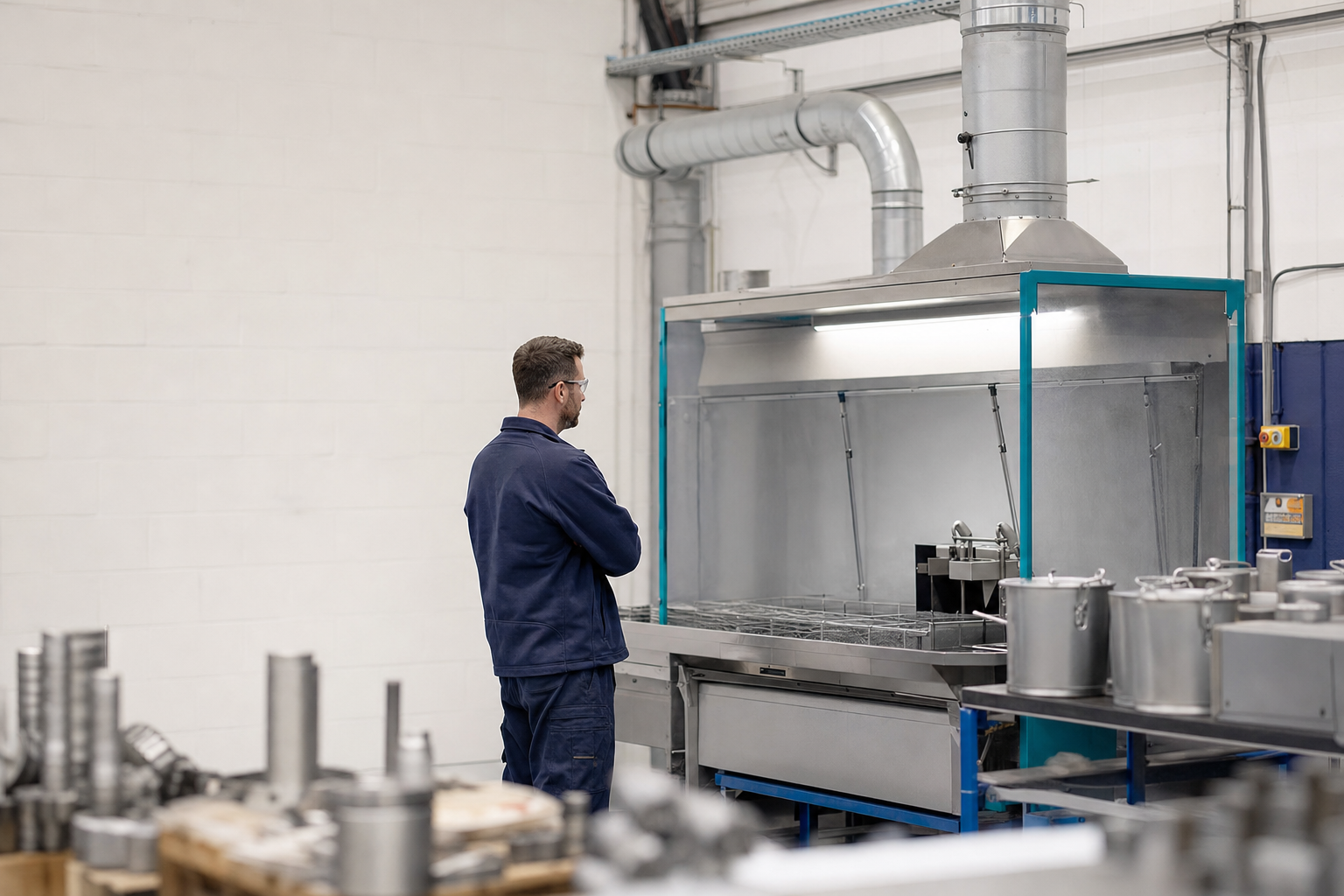
Local exhaust ventilation (LEV) captures contaminated air close to its source, before it spreads through the workplace. This could involve an enclosing hood, an extracted booth or another arrangement designed for the task.
Effective industrial fume control depends on more than a running fan. Check that the hood is correctly positioned, airflow indicators show the intended operating condition, and the work stays within the capture area.
Our HSG258 LEV guide explains these responsibilities. HSG258 is HSE's guidance publication on designing, commissioning, testing and maintaining effective LEV; it is guidance rather than a separate regulation.
Air moving through a duct is not proof that vapours are being captured where employees work.
6. Assess extracted-air treatment requirements
Extracted-air treatment deals with captured VOCs before discharge or, in a suitably designed system, recirculation. Different methods do different jobs:
-
Adsorption: compounds collect on a material's surface, such as suitable activated carbon. This differs from simply catching dust in a particle filter.
-
Recovery: a system separates and collects solvent from the extracted air.
-
Oxidation: a controlled treatment process chemically breaks down VOCs.
Select treatment through specialist assessment of the compound mixture, airflow, maintenance needs and discharge requirements. A particulate filter should not be assumed to remove solvent vapours.
7. Support controls with training and suitable protection
Working procedures should explain how to use controls, check their operation and report faults. Include what happens during cleaning or maintenance, when the normal production arrangements may change.
Respiratory protective equipment (RPE), such as an appropriately selected respirator, may be needed for particular tasks or residual exposure. Selection must match the substances and conditions involved, with face-fit testing where required to check that a tight-fitting facepiece seals to the wearer.
RPE protects the wearer when correctly selected and used. It does not reduce VOC generation or replace reasonably practicable higher-level controls.
Comparing manufacturing VOC control methods
Several measures may be needed together. Compare them by the problem each addresses, then decide how to verify the result.
| Method | What it addresses | What to verify |
|---|---|---|
| Elimination | Removes a VOC-generating material or task | Process suitability and remaining hazards |
| Substitution | Changes the source and its emission profile | Replacement hazards, performance and exposure |
| Controlled handling | Limits releases during transfer, use and storage | Actual working practices and waste arrangements |
| Enclosure and local exhaust ventilation | Limits spread and captures contaminated air | Capture during operating conditions and worker exposure |
| Extracted-air treatment | Removes, recovers or destroys captured compounds | Treatment performance and discharge requirements |
| Respiratory protective equipment | Reduces the wearer's inhalation exposure | Suitability, fit where applicable, maintenance and use |
How does HSE EH40/2005 apply to VOCs?
EH40/2005 is HSE's publication listing Great Britain's workplace exposure limits (WELs). A WEL is a concentration of a particular hazardous substance in air, averaged over a specified period. There is no single EH40 limit for every manufacturing VOC mixture.
Use the EH40 publication to identify the relevant substances, limits and accompanying information.
Match the substance and reference period
The reference period tells you the time over which exposure is averaged. The acronyms you will commonly encounter are:
- Eight-hour long-term exposure limit (LTEL): addresses exposure averaged over a longer time period — potentially representative of a whole shift.
- Fifteen-minute short-term exposure limit (STEL): addresses exposure averaged over a shorter period.
- Time-weighted average (TWA): used to measure the average exposure of a worker over a given time period (usually 8 hours).
Identify which limits apply before designing a survey. A shift average does not show whether a short-term limit was met during cleaning, and a brief spot reading does not represent an eight-hour exposure.
Keep COSHH duties wider than a numerical limit
COSHH requires prevention or adequate control of exposure. A result below a WEL is only part of that assessment: consider the process, control measures and other relevant exposure routes, including skin contact.
HSE's workplace exposure guidance also explains the additional requirement to reduce exposure to carcinogens, mutagens and asthmagens as low as reasonably practicable. These are substances capable of causing cancer, genetic damage or occupational asthma, respectively.
A numerical limit is not a universal guarantee of safety.
How does occupational hygiene verify VOC controls?
Occupational hygiene is the assessment and control of workplace exposures that could affect health. For VOCs, it connects the substance, the task and the way employees encounter it, then uses suitable measurements to evaluate control.
ARM Environments' workplace exposure testing assesses relevant airborne substances against applicable EH40 limits. The scope should reflect the processes, workers and reference periods being investigated.
Personal sampling for inhalation exposure
Personal sampling collects air close to the employee's breathing zone during the work being assessed. Active sampling uses a pump to draw air through a collection medium; passive sampling allows compounds to diffuse into a sampler without a pump. Select the method for the target compounds, expected concentrations and required duration.
Record the tasks, materials, production conditions and controls operating during the survey. The numbers become more useful when you know what happened while they were collected.
TVOC measurements for an appropriate question
Total volatile organic compounds (TVOC) is a combined measure rather than a list of individual substances. Such measurements can help investigate changes over time and locate possible emission events, but they do not establish compliance with every substance-specific WEL.
Instrument response and the mixture present matter.
ARM Environments' VOC testing service includes compound-level laboratory analysis, which identifies and measures individual chemicals. This supports source investigation and comparison with appropriate exposure benchmarks.
Assess the wider industrial contaminant mixture
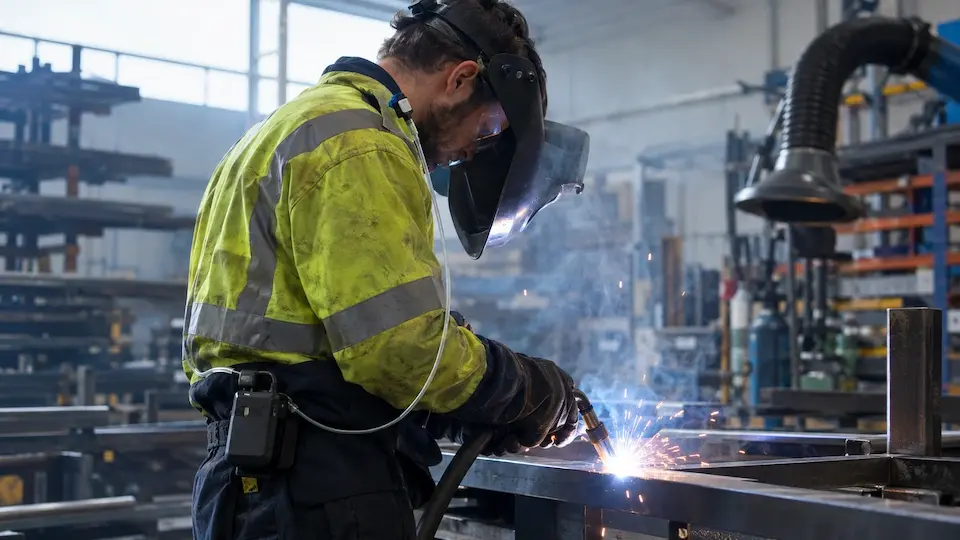
Industrial air quality testing should address what the process generates, not just what a VOC instrument can detect. Welding fume, dust and machining mist require suitable assessment methods of their own. Where sources are uncertain, indoor air quality testing can support the initial investigation, but its scope should remain distinct from a targeted occupational exposure survey.
Build a practical VOC reduction plan
A useful plan identifies the source, the action, the person responsible, and how performance will be checked. Let your COSHH assessment guide the priorities.
Address known control failures promptly. Testing can investigate uncertainty and verify improvements, but it should not delay an established protective measure where the need is already clear.
Map the complete working cycle
Include production, start-up, shutdown, product changes, cleaning, maintenance and waste handling. For each activity, record:
- The materials and potential contaminants.
- The workers involved and where they work.
- The controls in place.
- What remains uncertain about exposure or control.
This gives a competent assessor a useful basis for planning industrial hygiene air quality testing. It also avoids requesting the same test panel for areas with quite different processes.
Prioritise controls and define success
Prioritise actions according to the hazards, likely exposure and effectiveness of existing controls. Assess elimination and substitution first, then consider containment, extraction and working practices. Assign responsibility for implementation and subsequent checks.
Define the intended outcome. Removing an open transfer step, achieving the designed capture performance and demonstrating adequate exposure control are different objectives, each requiring different evidence.
Compare before and after under meaningful conditions
Before-and-after testing is useful when the conditions allow a meaningful comparison. Record material use, task duration, production activity and ventilation conditions alongside the results.
A lower reading on a quieter production day does not isolate the benefit of new extraction.
Explain differences between sampling days and decide whether more measurements are needed before attributing a change to the control itself.
Document review triggers and ongoing checks
Review the assessment when materials, equipment, layout or working practices change, or when evidence suggests controls are deteriorating. Monitoring frequency should reflect the risk and previous findings, rather than an assumed annual rule for every site.
HSG173 is HSE's guidance on planning inhalation exposure monitoring: deciding what to sample, when to sample and how to interpret the results. Our HSG173 monitoring guide explains how initial appraisal and further sampling fit together.
Keep that exposure-monitoring programme separate from the inspection and examination arrangements required for control equipment.
Choose the next action from the evidence
Where the source or exposure pattern is unclear, define the unanswered question before buying treatment equipment or commissioning a broad monitoring package. You may need to identify the chemicals, investigate a particular task or establish whether existing extraction captures the release.
ARM Environments' industrial fume testing service connects process information with airborne contaminant assessment and practical recommendations. Bring material information, process details and existing reports so the investigation addresses the decisions you need to make.
Frequently asked questions about manufacturing VOC reduction
What are the main methods to reduce VOC emissions?
Elimination, substitution, controlled handling, enclosure and extraction are the main methods to assess. Treatment of extracted air may also be needed. Choose controls for your substances and process, then check their operating performance and the exposure conditions employees experience.
Can general ventilation control manufacturing solvent exposure?
General ventilation can support control, but suitability depends on the source and work involved. Assess whether vapours require capture at source. Room-average measurements alone may not describe what an employee breathes during a particular task.
Does a low TVOC reading prove EH40 compliance?
No, a total VOC reading does not identify each chemical or show whether its workplace exposure limit has been met. Identify the compounds and applicable reference periods, then select appropriate sampling. ARM Environments provides compound-level analysis and workplace exposure testing to support that assessment.
How often should manufacturing VOC exposure be tested?
Frequency depends on the risk assessment, process stability and previous findings. Review the need when substances, controls or working conditions change. ARM Environments can help scope an assessment around the site's activities rather than assume every facility needs the same testing schedule.