How EVT Dust Sampling Works: Testing Ductwork Cleanliness
Dust builds up inside ductwork whether you can see it or not. EVT dust sampling — still widely known by its older name, PVT (Preferred Vacuum Test) — is the standard method used to measure exactly how much of it is there, and whether it's time to clean. This guide explains how the test works, what the results mean, and when it's used, in plain terms for facilities managers and building owners who need to stay compliant without needing an engineering degree to understand why.
If you're responsible for a ventilation system, this is one of the few ways to get an objective answer to "does this actually need cleaning?" rather than a guess based on how long it's been since the last service.
See our ductwork cleaning service if you already know you're due a ductwork clean.
What is EVT (PVT) dust sampling?
EVT dust sampling is a controlled vacuum test that measures the exact weight of dust sitting inside your ductwork, expressed in grams per square metre.
It's specified under BS EN 15780 (the British/European standard for ventilation system cleanliness) and TR19 Air, BESA's UK industry guidance — see our full guide to TR19 Air for the complete standard. The test was originally called PVT (Preferred Vacuum Test), and you'll still see this name used across the industry, including on equipment and older documentation, but current guidance refers to it as EVT (European Vacuum Test). Same test, new name.
Unlike a visual inspection, which relies on judgement, EVT gives a measurable, lab-verified figure. That figure gets compared against set thresholds to decide if a system passes or needs cleaning.
How does EVT (PVT) dust sampling work?
The process is straightforward, even though it looks technical up close.
| Step | What happens |
|---|---|
| 1. Template placed | A 100mm × 100mm template is fixed to a representative section of duct surface |
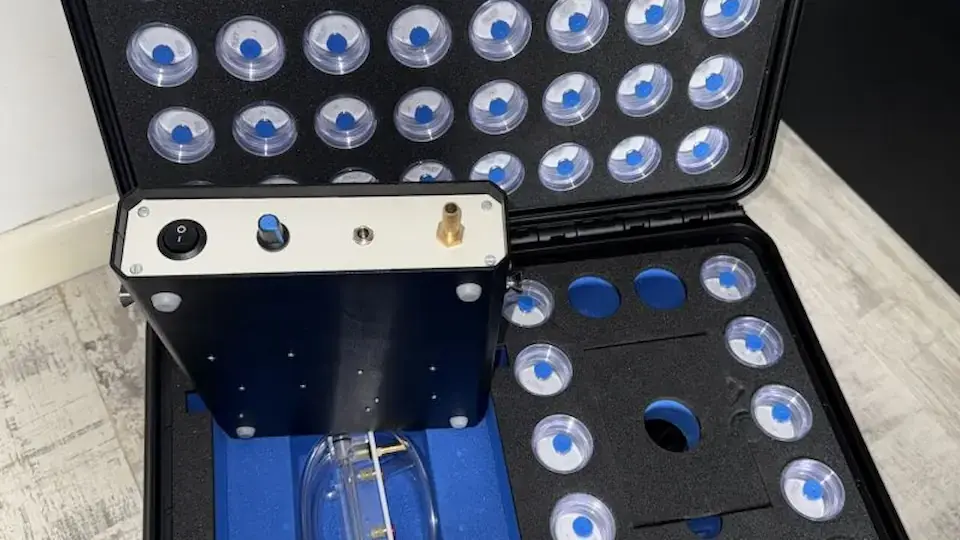
| 2. Vacuum sampling | A calibrated vacuum unit draws dust from within the template area onto a pre-weighed filter cassette |
| 3. Filter reweighed | The cassette is weighed again to calculate exactly how much dust was collected |
| 4. Lab analysis | Samples are sent to a UKAS-accredited laboratory to confirm the dust loading, recorded in mg/m² or g/m² |
| 5. Result compared | The figure is checked against BS EN 15780 thresholds for that duct's classification |
Every part of this is designed to be repeatable; the same test, done the same way, on the same duct, should give the same answer regardless of who's carrying it out. That's the whole point: it takes the guesswork out of "is this duct clean."
What do EVT (PVT) results mean?
Once the lab returns a dust loading figure, it's checked against BS EN 15780's Table 2, which sets acceptable dust levels based on:
- Whether the ductwork is supply or extract
- The system's cleanliness classification (low, medium, or high — set by the type of building and how critical air quality is, e.g. a hospital vs a warehouse)
If the measured dust loading is above the threshold for that classification, the duct is flagged for cleaning. If it's below, the system passes.
Note: exact threshold figures vary by classification and are set out in BS EN 15780 and TR19 Air directly — always check the current published tables rather than relying on a summary, as these are periodically reviewed. Our TR19 Air 2026 update guide covers the latest version.
When is EVT (PVT) testing used?
EVT/PVT sampling shows up at a few key points in a ductwork's lifecycle:
- Pre-clean assessment: establishing a baseline before deciding whether (and how) to clean
- Post-clean verification: this is the important one. Both BS EN 15780 and TR19 Air specify EVT/PVT as the only accepted method for confirming a duct has actually been cleaned to standard
- Routine compliance checks: supporting duties under the Workplace (Health, Safety and Welfare) Regulations 1992, which reference BS EN 15780 as the benchmark for ductwork cleanliness. See Duct Cleaning: UK Laws and Guidelines for the wider legal picture.
If your ductwork cleaning was carried out under TR19 Air, EVT/PVT results are what prove the job was done to standard, not just a "looks clean to me" sign-off which seems to be the signature move of dodgy contractors that we see far too often.
Dust testing methods for ductwork
EVT/PVT isn't the only way to check a duct, but it's the most reliable.
| Method | How it works | Best for |
|---|---|---|
| EVT (PVT) | Vacuum sampling, lab-analysed | Post-clean verification, formal compliance |
| DTT (Deposit Thickness Test) | Measures how thick the dust layer is, gives an instant on-site reading | Quick pre-clean checks |
| Visual inspection | Camera/borescope check of duct interior | Initial condition assessment, not a measurable pass/fail |
DTT is useful because it's instant — no lab wait. But when you need a defensible, standard-compliant answer, EVT/PVT is what both BS EN 15780 and TR19 Air require.
Frequently Asked Questions
Is PVT the same as EVT?
Yes. EVT (European Vacuum Test) is the current name for what was previously called PVT (Preferred Vacuum Test). The method of dust testing itself hasn't changed.
How often should EVT testing be carried out?
The frequency of ductwork dust sampling depends on your system's use and classification. Our guide on how often you should clean your air ducts covers typical intervals, and our TR19 Air updates tracker covers how testing requirements have evolved.
Can I skip EVT testing if the duct looks clean?
Visual inspection alone doesn't meet BS EN 15780 or TR19 Air requirements for verification — dust that isn't visible to the eye can still exceed acceptable thresholds. EVT samples are required for BS EN 15780 and TR19 Air compliance.
Talk to an Expert
Need your ductwork tested or cleaned to TR19 Air standard? Get in touch and we'll talk you through what EVT (PVT) sampling would involve for your building, or head straight to our ductwork cleaning page to see the full service.