High CO2 in the Office: Causes, Risks, and What to Do
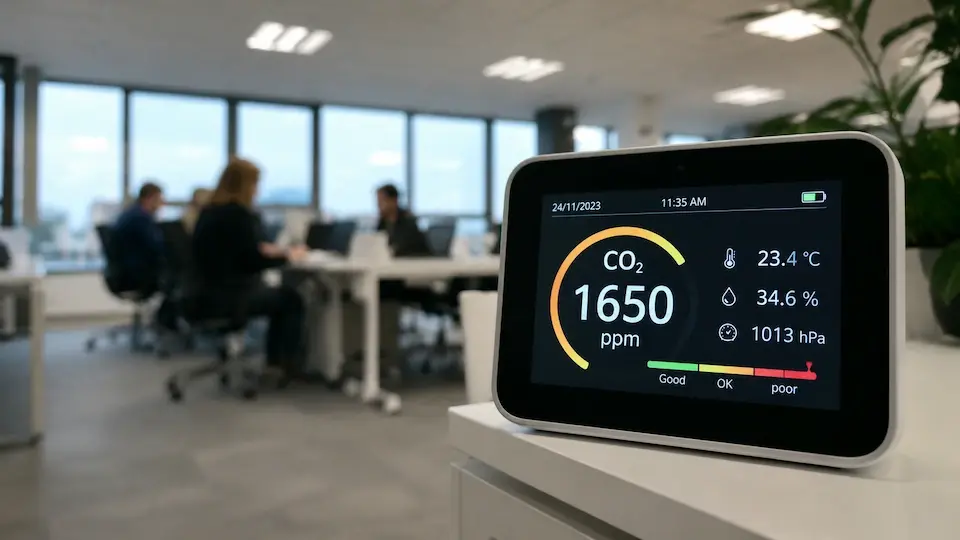
CO2 is one of the simplest and most useful indicators of how well a space is ventilated. Because occupants themselves produce it with every breath, rising CO2 concentrations track fresh air supply almost in real time — a stuffy meeting room by 11am is rarely a coincidence.
When workplace CO2 climbs above expected levels, it's a signal worth investigating rather than a nuisance to mask with an open window or a fan. Persistent high readings usually point to a ventilation shortfall that also affects other pollutants — which is exactly what indoor air quality monitoring is designed to uncover.
This guide covers what causes high CO2 in offices and workplaces, what the health and productivity effects are, how to measure it properly, and what steps actually fix the problem.
For a more macro view at indoor air quality testing, view our 2026 guide.
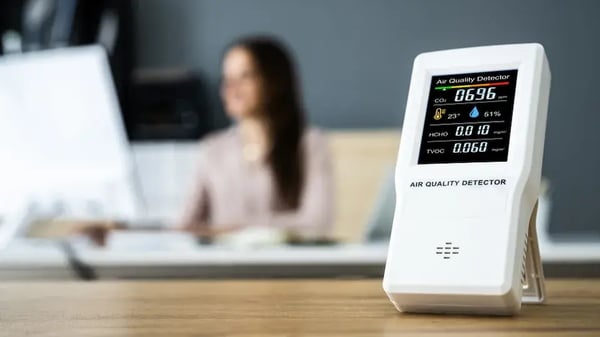
Facilities managers and business owners concerned about pollutant exposure, check out our Workplace Exposure Limits testing page.
What Causes High CO2 Levels in the Workplace?
High workplace CO2 almost always comes down to a mismatch between how much fresh air a space receives and how much is needed for the people and activity inside it.
Insufficient Fresh Air
If the volume of outdoor air entering a space is too low for the number of occupants, CO₂ builds up. This can be a design issue, a system fault, or simply a space being used more intensively than it was originally intended for.
Poorly Performing Mechanical Ventilation
Fans running below design speed, faulty controls, or units that have never been properly commissioned will under-deliver fresh air even though they appear to be working.
Occupancy Levels
More people in a room means more CO2 produced per minute. A space that performs fine at half capacity can tip into poor territory once fully occupied. Meeting rooms and training spaces are common offenders.
Blocked, Dirty, or Poorly Maintained Filters
Clogged filters restrict airflow through an AHU or FCU, reducing the volume of air actually being supplied even when the system is nominally running.
Poorly Balanced Ventilation Systems
Supply and extract airflows that aren't balanced against each other can leave some rooms starved of fresh air while others are over-ventilated, regardless of what the system as a whole is delivering.
Doors, Windows, and Changes to Building Use
Rooms repurposed without a ventilation review (e.g., a store cupboard turned into an office, a single office now used for hot-desking) often inherit a ventilation rate designed for a different use entirely. Sealed windows and doors kept shut for security or noise reasons only compound the issue.
Why Are CO2 Levels High When There Are Only a Few People in the Room?
Unexpectedly high CO2 in a lightly occupied room almost always points to a ventilation system problem rather than an occupancy problem. If a handful of people is enough to push readings up quickly, the room probably isn't receiving anywhere near its design fresh air rate.
| Issue | What it looks like |
|---|---|
| Supply air fault | Diffusers delivering little or no air despite the system running |
| Extract air fault | Stale air not being removed, allowing CO2 to accumulate |
| Poor air distribution | Fresh air short-circuiting to the extract without properly mixing through the room |
| Closed dampers or ductwork faults | Airflow physically restricted somewhere between the AHU and the room |
| Zone imbalance | Ventilation rate calculated for the building, not the specific room |
A single spot reading rarely tells the full story here — a low CO2 reading first thing in the morning and a high one by mid-afternoon both need to be seen to understand what's really happening. This is where continuous monitoring and a proper ventilation validation earn their keep.
What Are Normal CO2 Levels in an Office?
Outdoor CO2 typically sits around 420 ppm. Indoor levels will always be somewhat higher due to occupant breathing, but the size of that gap is what indicates ventilation performance.
- Below 800 ppm — generally considered good ventilation
- 800–1,000 ppm — acceptable in most office settings, though worth watching in meeting-heavy spaces
- Above 1,000 ppm — CIBSE guidance commonly flags this as indicating inadequate fresh air supply
- Above 1,500 ppm — associated with a marked drop in perceived air quality and complaints
These figures are commonly referenced thresholds, not hard legal limits — treat them as indicators of ventilation performance rather than compliance pass/fail marks, and always check current CIBSE and HSE guidance for the specific figures applicable to your assessment.
Context matters more than the number in isolation: a reading of 900 ppm in an empty room at 8am is a different story to the same reading in a packed meeting room. Occupancy, time of day, and what the ventilation system is designed to deliver all need to be factored in.
What Are the Effects of High CO2 in the Workplace?
Drowsiness and Fatigue
Occupants in poorly ventilated spaces commonly report feeling tired or sluggish, particularly in long meetings or by the end of the working day.
Reduced Perceived Air Quality
Rooms with high CO₂ are frequently described as "stuffy" or "stale" — occupants can sense the ventilation shortfall even without knowing the exact figure.
Headaches and Discomfort
Sustained exposure to elevated CO₂ is associated with headaches and general discomfort, adding up to real productivity and wellbeing costs over a working week.
Reduced Concentration and Productivity
Cognitive performance — particularly decision-making and complex thinking — has been shown to decline as CO2 rises, making this a genuine business cost, not just a comfort issue.
We've got a more detailed blog diving into the topic of IAQ and productivity here.
Can CO2 Indicate Other Air Quality Problems?
Yes. Because CO2 tracks fresh air supply, a space with high CO2 is also likely accumulating other pollutants generated indoors — VOCs, particulates, and bioaerosols — that aren't being diluted or removed either. High CO2 is rarely a problem in isolation.
Is High CO2 Dangerous?
Typical workplace CO2 concentrations, even elevated ones in the 1,000–2,000 ppm range, are fortunately not acute health hazards in the way very high industrial exposures can be. The concern in office and commercial settings is comfort, cognitive performance, and what elevated CO2 indicates about the wider ventilation and air quality picture, rather than direct toxicity. However, concentrations above 800ppm have been shown to decrease performance on cognitive tasks, indicating that poorly-ventilated workspaces can reduce productivity.
Genuinely hazardous CO2 concentrations (well above what's typically seen in offices) fall under occupational exposure limits rather than ventilation guidance, and are a different category of problem entirely. For the vast majority of workplace situations, high CO2 should be read as a ventilation performance indicator, and should prompt a look at the wider indoor environment rather than treating the CO2 figure as the whole story.
How Do You Measure CO2 in an Office?
Portable CO2 Measurements
Handheld or portable meters give a useful spot-check of conditions at a single point in time — helpful for quickly confirming a complaint or comparing rooms, but limited by only capturing one moment. Cheap consumer-grade sensors work fine for this case, but going down this route means that you will be missing the input from a real professional on what to do with the information. See more on why CO2 monitoring alone isn't enough.
Continuous CO2 Monitoring
Fixed sensors logging data over hours, days, or weeks build a much more complete picture, capturing how levels change with occupancy, time of day, and system operation. Many offices have some form of air quality monitor installed, but we often see them covered up, swept away, and forgotten about. CO2 monitors installed in suitable positions across a building still can't tell the full story until you have an expert assess the greater ventilation strategy and space requirements.
Using CO2 Data to Assess Ventilation
CO2 trends — rate of rise, peak levels, and how quickly a room recovers after occupants leave — reveal far more about ventilation adequacy than a single number ever could. However, interpreting this data can be tricky, which is why we always recommend calling a professional who can see the bigger picture and reveal the nuances in your air quality data.
Why Location and Monitoring Duration Matter
Sensor placement affects results significantly: a monitor too close to a door, window, or diffuser will give a misleading reading, and we often come across sensors that have genuinely been covered up with posters or decorations.
Monitoring needs to run long enough, and in the right locations, to capture normal occupancy patterns rather than an unusually quiet or busy day; one sensor in the corner of a room that people barely inhabit will not yield particularly useful air quality data. Equally, placing a sensor on the table of a busy meeting room could cause some panic — simply because there are a dozen people breathing around it. The whole space needs to be measured to properly determine how well the space is being ventilated to remove CO2.
How Do You Fix High CO2 Levels in the Workplace?
Increase the Supply of Fresh Air
The most direct fix: raising the volume of outdoor air being delivered, either by adjusting system settings or increasing capacity where the system allows. Natural ventilation strategies allow for windows and doors to be open more frequently, or for longer, throughout the day, particularly before CO2 starts to peak.
Check and Maintain the Ventilation System
Blocked filters, faulty fans, and uncommissioned controls are common culprits and often the cheapest fix once identified. You'd be surprised how many clients don't even realise they have decade-old filters falling apart in their ventilation system. A quick HVAC system check takes just a few hours and can save you a lot of headache in the long-run.
Investigate Poor Air Distribution
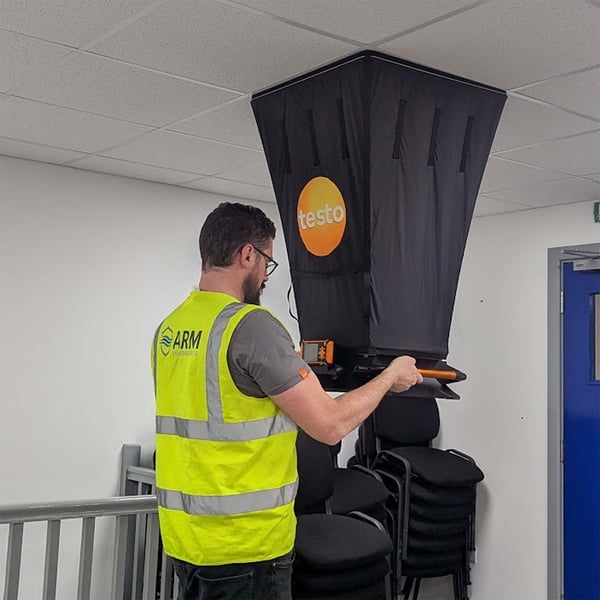
Even a system delivering enough fresh air overall can leave specific rooms under-ventilated if that air isn't distributed properly — this needs looking at room by room, not just at the plant. This should be carried out by a professional with equipment suitable to accurately measure airflow and indoor air quality, as a DIY attitude can lead to under-ventilation in other rooms or place additional stress on the ventilation system's fans, filters, and coils.
Consider Occupancy and Changes in Building Use
Where a room's use has changed since the ventilation was designed, the fix may be a review of occupancy limits or a redesign of the ventilation strategy for that space, not just a mechanical repair. Where ventilation systems can't be upgraded due to space or budget, we can help provide recommendations on how your space should be laid out for the best air quality in each room.
Review Airflow Rates
Comparing actual delivered airflow against the design rate for the space and its current occupancy shows whether the system is under-performing or simply undersized for how the room is now used.
See our ventilation validation service for more details, or read our case study on how we verified airflow rates were sufficient in a vehicle depot.
How Can Indoor Air Quality Testing Investigate High CO2?
A proper investigation looks well beyond the CO2 number alone:
- CO2 alongside temperature and relative humidity: establishing whether ventilation issues are compounding thermal comfort problems
- Particulate matter and TVOCs: checking whether other pollutants are accumulating alongside CO2
- Airflow and ventilation assessment: measuring what's actually being delivered against what the space needs
- Longer-term monitoring where intermittent issues are suspected: capturing patterns that a single site visit would miss
Where an intermittent or hard-to-pin-down issue is suspected, ongoing IAQ monitoring gives a far more reliable picture than a one-off visit.
When Should a Business Arrange CO2 Monitoring?
- Persistent employee complaints about stuffiness, tiredness, or headaches
- Stuffy rooms that are noticeably worse than the rest of the building
- High readings from existing sensors, particularly if smart building systems are already flagging elevated levels
- Changes to occupancy or building use — more desks, different room functions, higher footfall
- Suspected ventilation faults following recent works, refurbishment, or system age
Talk to ARM Environments about Office CO2 Monitoring
If employees are reporting stuffy rooms, headaches, or fatigue, it's worth investigating rather than guessing. ARM Environments' IAQ Monitoring service identifies exactly what's driving high CO2 and what to do about it. Get in touch to arrange an assessment.
FAQs About Carbon Dioxide in the Office
What CO2 level is too high in an office?
Readings consistently above 1,000 ppm are commonly treated as indicating inadequate ventilation, with levels above 1,500 ppm associated with noticeably reduced perceived air quality and increased complaints.
What causes CO2 to rise indoors?
Indoor CO2 rises when occupant-generated CO2 isn't being diluted or removed quickly enough — most often due to insufficient fresh air supply, underperforming mechanical ventilation, high occupancy, or poor air distribution within a room.
Can high CO2 make you tired?
Yes — elevated CO2 is commonly linked to drowsiness, fatigue, and reduced concentration, particularly during long periods in the same room.
How long should you monitor CO2 in an office?
CO2 in offices should be monitored long enough to capture typical occupancy patterns — this usually means at least a full working week, so both quiet and busy periods are represented rather than a single snapshot.
Does high CO2 always mean poor ventilation?
In the vast majority of workplace cases, yes — CO2 is one of the most reliable practical indicators of ventilation adequacy, though occupancy and room use should always be considered alongside the reading rather than the number in isolation.