Part F 2026: What the Ventilation Update Means For You
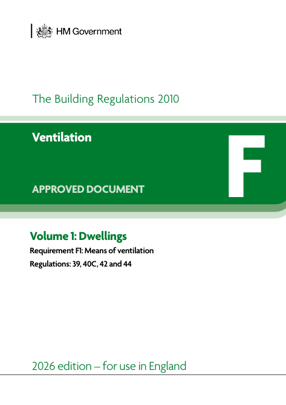
Volume 1 of Approved Document F (Ventilation), has been updated for 2026. The new edition sets mandatory whole-dwelling ventilation rates and tightens requirements around installation and handover. If you're involved in specifying, building, or maintaining ventilation systems, here's what's actually changed and when it applies.
Important note: Volume 2 has currently not been updated alongside Volume 1. In this article we will discuss the update to Part F: Volume 1 (dwellings), but, as of writing, Volume 2's (non-dwellings) latest edition is from 2021. As the government officially notes:
"Earlier versions of Approved Document F continue to apply to buildings subject to previous regulatory standards. See Ventilation: Approved Document F for guidance covering earlier requirements."
You can access the new standards here:
What's changed in Part F 2026?
In terms of ventilation rates and strategies, the 2026 edition of Approved Document F, Volume 1, is largely familiar. The core approach of setting whole-dwelling ventilation rates by bedroom count remains, along with the requirements for background ventilators and minimum ventilation provision that installers already work to.
The more significant changes sit around the regulatory framework, commissioning, and the information handed to homeowners. The wider 2026 Future Homes and Buildings Standards introduce Regulation 40C, a new requirement for information about a building and its systems to be handed to the homeowner in a format they can actually use, rather than buried in a technical manual.
Approved Document F ties its ventilation requirements to this handover obligation, while the detailed requirements for the Home User Guide sit in Approved Document L. In practice, this means homeowners should receive clear, accessible information that explains how their ventilation system is meant to operate, including why it needs to stay running and how it should be maintained rather than switched off at the first sign of noise.
Commissioning is being taken more seriously alongside this. MVHR systems now need proper sign-off with a certificate, and MEV systems need checking against their design airflow rates rather than just switched on and left. None of this changes what goes in the wall, but a kinked, undersized, or leaky duct run is now far more likely to get caught before sign-off than it was before.
The intent behind Regulation 40C is straightforward: close the gap between how a ventilation system is designed to perform and how it actually performs once people are living in the building. A ventilation validation check at handover is one of the few ways to confirm a system meets Part F requirements before that responsibility passes to the homeowner.
Industry Insight: An Air Quality Perspective
From an air quality expert's point of view, this regulatory pivot toward user understanding is a massive step forward. Historically, many indoor air quality issues, such as severe condensation, mould proliferation, and the dangerous build-up of VOCs (Volatile Organic Compounds), haven't stemmed from a lack of equipment. Instead, they happen because occupants turn off continuous extract fans or block trickle vents to stop drafts or fan noise.
By legally mandating that handover documentation is provided in a non-technical, user-friendly format, the 2026 update attacks the "performance gap" directly. An air quality expert would tell you that the best mechanical ventilation system in the world is useless if the homeowner turns it off at the breaker. This update ensures users are educated on why their ventilation matters for their health and the building's fabric.
When do the new Part F ventilation rules apply?
The 2026 edition of Approved Document F takes effect on 24 March 2027 for standard building work, and 24 September 2027 for higher-risk buildings. Transitional arrangements mean projects that begin before March 2028 can, in some cases, still follow the previous standard. In practice, most projects being designed now should already be working towards the 2026 handover and commissioning requirements.
Does the 2026 Part F update affect non-domestic buildings too?
The Future Homes and Buildings Standards update focuses on Approved Document F, Volume 1, which covers dwellings. Anyone working across mixed-use or commercial developments should treat domestic and non-domestic documents separately, rather than assuming Volume 1 changes automatically carry across to all commercial spaces.
Approved Document L (energy efficiency) received a comprehensive update alongside Part F, so ensure you are referencing the correct volumes for your specific building type.
What the Part F update means for installers and specifiers
For airtight new builds relying on continuous mechanical ventilation (MEV or MVHR), compliance is no longer just about installing the right unit to meet a spreadsheet target. The burden of proof has increased. Commissioning has to be meticulously verified, tested, and documented. Furthermore, systems must be fitted by competent persons who can bridge the gap between technical installation and consumer handover, ensuring the mandated Home User Guide accurately reflects the installed system.
What to do now
If you're specifying or delivering residential ventilation work, it is worth adopting the 2026 commissioning and handover practices now rather than waiting for the 2027 compliance date to arrive. For existing buildings undergoing significant retrofit or refurbishment, checking whether current ventilation provision meets standard whole-dwelling rates is a useful early step, particularly before airtightness work goes ahead and changes the picture.
As with any regulation update, always check figures and requirements against the current published version of Approved Document F before treating them as final.
Get in touch
If you need to check how a building's ventilation performs against current or upcoming standards, ARM's Ventilation Validation service assesses systems against the requirements that matter for your project. Get in touch to talk through what the Part F update means for your building.