
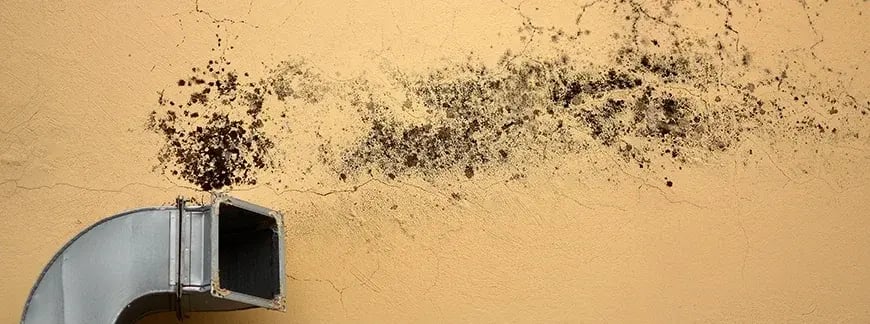
Mould
- Sources
- Impacts
- Testing
Sources of Mould
Mould spores are practically impossible to remove entirely, as they exist naturally in the air and can originate from decaying animal/plant matter even outside your home or workplace.
Indoors, mould is caused by excessive dampness (sometimes due to poor construction or maintenance, or by improper behaviour from the building's occupants) and warm indoor temperatures. Mould thrives in the 30°C-35°C temperature range when relative humidity is around 60%.
Many buildings experience condensation as the primary source of indoor moisture. Without an appropriate and effective ventilation system, this can become the perfect indoor environment for mould to grow.
Common indicators of excessive mould growth include a musty odour or visible water damage.
Airborne pollutants can also effectively indicate indoor mould growth: high levels of particulate matter, CO2, MVOCs, and mycotoxins can be associated with an increased density of airborne fungal spores.
Typical Causes of Indoor Mould
- High Humidity
- Water Damage
- Poor Ventilation
- Condensation
Impacts of Mould
A warm indoor environment with plenty of moisture is the perfect breeding ground for mould to grow excessively. When mould continues to grow, it increases the exposure to all occupants within the building, which can lead to a variety of health risks. Most commonly, inhalation of mould spores can lead to asthma, but it can also cause airway infections and rhinitis. Some species of mould, like Stachybotrys (Black mould), are especially harmful to human health. The risk of developing mould-related illnesses increases significantly for groups with underlying health conditions or vulnerable groups such as the young, the elderly, or those with compromised immune systems, and the severity of illness can even lead to death in some individuals. In less severe cases, mould exposure can cause irritation of the eyes and skin, leading to conjunctivitis or eczema, respectively. There is also a correlation between increased mould exposure and negative mental health effects, like depression, anxiety, insomnia, and cognitive impairments. Furthermore, it's possible that long-term mould exposure can also lead to the development of neurodegenerative diseases. Over long enough periods, excessive mould growth can even reduce the structural integrity of buildings through rot and decay, weakening particularly susceptible building materials like wood, plaster, and paint.
Common Impacts of Mould
- Reduced Respiratory Health
- Reduces Structural Integrity
- Long-Term Negative Health Effects
- Negative Odour and Visual Perception
Testing for Mould
When testing for mould, we can determine the types of mould present as well as the amount (known as the CFU level). Within the UK, there is no specific limit for mould, although landlords are mandated to reduce mould if it impacts the health of the occupants (Landlord and Tenant Act, 1985; The Housing Act, 2004). Unfortunately, this creates a bit of a grey area and results in unclear definitions of limits.
To measure the presence of mould, we may use relative fluorescence units (RFUs), as this is a good indicator of whether mould growth is occurring in the air or on surfaces within the testing environment. In the air, >1700RFU indicates that mould growth is present, whilst the same is true for >450RFU on surfaces.
Alternatively, we may use Agar plates to determine the level of colony-forming units (CFUs) through either air (pumped or passive) and surface sampling. These help to distinguish the species and quantities of mould over a 10-day incubation period.
Test Methods for Mould
- Air Sampling
- Surface Swab Sampling
- Microscopic and Macroscopic Methods (Agar CFU Level)
- RFU Detector
Get Mould Tested
We offer in-person mould testing services in the UK.
Mould FAQs
How Do I Remove Mould from My Indoor Air ↓
To determine the extent of a mould infestation, we would first conduct preliminary mould surveys. Moulds can grow on water-damaged or damp materials, and these would be removed where practical. Some items of furniture, plaster walls, or specific types of paint can also easily host colonies of mould. Areas where mould may be difficult to remove include cellulosic materials (e.g., gypsum board and fibreboard) and absorbent materials like fabrics, and may need to be destroyed rather than cleaned. Hard surfaces, like concrete floors and ceramic tiles, can be cleaned of mould rather easily.
To prevent mould from growing in the long term, it can help to keep the indoor environment dry, as mould thrives in high humidity. Air quality monitoring is important to ensure the air remains at the right temperature and humidity, and can provide an early warning signal if your dehumidifiers or HVAC systems become faulty or require replacement air filters. As mould can regrow quickly within 12 months, short-term remediation efforts may not work in the long term. Alongside maintaining an appropriate temperature and humidity level, post-remediation verification tests should also be conducted periodically to ensure there is no regrowth of mould inside the building.
What Types of Mould Can You Identify? ↓
What Specific Legislation Relates To Mould In The United Kingdom? ↓
Housing Act 2004, Environmental Protection Act 1990, Homes (Fitness for Human Habitation) Act 2018, Landlord and Tenant Act 1985, Decent Homes Standard, Minimum Level of Energy Efficiency Standard, Building Regulations 2010, COSHH 2002. (WHO Guidelines for Indoor Air Quality, 2009).
Why Can You Only Detect Mould To The Family Level? ↓
Accurately classifying mould to the species level becomes an issue as distinguishing factors from each mould type become more difficult to discern. Specialist lab equipment is needed to accurately identify moulds at this level.
Are Some People More Vulnerable To Mould Exposure? ↓
Yes - Children and the elderly are especially vulnerable as they have either underdeveloped or compromised respiratory systems. Anyone with respiratory/ pulmonary conditions, frequent allergic reactions or those who are immunocompromised may also be vulnerable.
What Am I At Risk Of Inhaling Specifically When In A Mouldy Indoor Space? ↓
Mould can produce in the air via its natural metabolism; Mycotoxins (secondary pollutants produced by mould growth which are toxic to humans); mVOCs (volatile carbon compounds which evapourate in air, harmful to humans in high dosages); CO2 (respiratory bi-product of mould growth); Particulate Matter (in the form of spores or dead cells).
Why Choose ARM?
ARM delivers accurate mould testing, expert remediation advice, and post-remediation verification.
We’re SafeContractor certified and a proud member of BESA. Our CEO, Adam Taylor, chairs the BESA Indoor Air Quality Group, ensuring our services meet and exceed the latest industry standards.
From damp investigations to long-term prevention strategies, we provide complete support to help you manage mould and protect health.