

Mould Surveying in London Care Home: Case Study
Ageing lungs, compromised immune systems, and long-term health conditions make poor air quality far more dangerous for older residents. A mild patch of damp that might barely trouble an 18-year-old can become a serious health concern for someone over 65 who spends most of their time indoors.
It is precisely that vulnerability gap that made this case study from a South West London retirement home such a significant one — and the property manager's decision to act early such an important lesson for the sector.
For more details on our Mould Testing service, click here.
The Situation: Water Ingress in a South West London Retirement Home
ARM Environments was called to a newly built retirement home in South West London following reports of water ingress along an internal wall between two flats. No visible mould growth had appeared at the time of instruction, but the property manager made the decision to commission a mould air quality assessment before any problem became established. The driver for that early action was a resident in one of the affected flats with longstanding respiratory conditions — someone for whom elevated mould spore levels could have serious consequences well below the concentrations that would concern a healthier occupant.
Broadly, the retirement home's residents fit an older demographic (65+), and this population is known to have a lower exposure threshold for mould-related health effects. Weakened immune systems, existing allergies, and chronic respiratory conditions all reduce the margin between a safe environment and a harmful one.
Learn more about air quality for vulnerable groups.
How We Carried Out the Mould Testing Assessment
Our scope of work covered two affected flats with a total of five sampling locations across multiple rooms in each. We also sampled the ground floor restaurant area, which had no history of water damage, to serve as a clean benchmark for comparison.
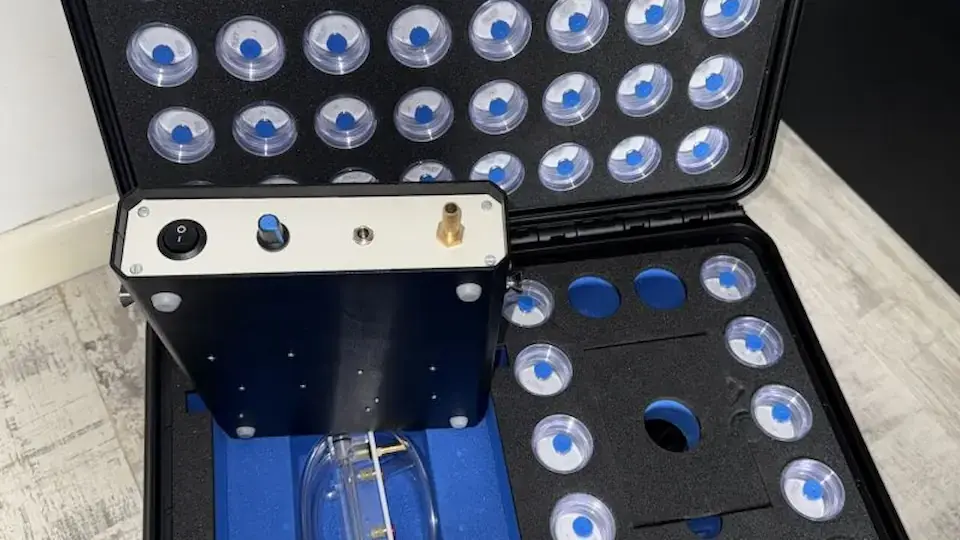
Microbial load measurements were taken using a Parret Active Air Sampler at 500 litres per second, exposing tryptose soya agar (TSA) plates to ambient air in each microenvironment. Collected samples were incubated under controlled conditions — first at 32.5°C for 48 hours to encourage bacterial growth, then adjusted to 25.5°C to promote fungal development. Results were reported as colony forming units per cubic metre (CFU/m³), identified to genus and species level where possible, and assessed against WHO Indoor Air Quality guidelines for dampness and mould (2009).
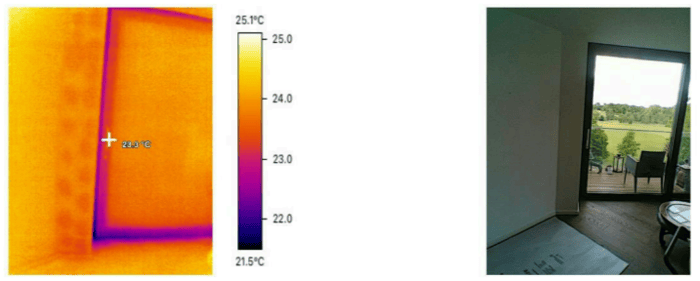
In addition to air sampling, we used thermography imaging (testo 860i) across both apartments to identify surface temperature variations that might indicate hidden moisture. Surface temperature, air temperature, and relative humidity were all recorded to build a full picture of conditions in each room.
Read more about our air sampling methodology
What the Mould Testing Found
CFU levels were generally within low, acceptable limits across both apartments — but the picture was not entirely reassuring. The master bedroom of apartment 50 recorded 620 CFU/m³, which sits in a range that some sources classify as elevated and which is broadly understood to exceed acceptable levels for general indoor air quality, particularly where vulnerable occupants are present. Residents with respiratory conditions, allergies, or weakened immune systems may begin to experience negative health effects at concentrations that would cause no symptoms in a healthy adult.
The lowest reading in the affected flats came from the guest bedroom of apartment 66, at just 44 CFU/m³ — likely reflecting its distance from the water-damaged wall and the fact that the room had remained closed throughout the remediation works. The restaurant benchmark area returned 209 CFU/m³, consistent with a space that had no history of water damage and good baseline ventilation.
Relative humidity and surface temperature readings were not indicative of active mould growth conditions at the time of testing — the environment was too dry to sustain it. The origin of the mould spores detected therefore remained inconclusive from air sampling alone: ambient spores entering via the ventilation system could not be ruled out. Surface swabbing in the areas of previous water damage and at ventilation inlets would provide a more definitive picture of where elevated counts are originating, and this was noted as a recommendation for any further investigation.
In principle, every tenant deserves equal protection, and IAQ issues should be dealt with long before they reach crisis point. Yet, as the introduction of Awaab's Law makes painfully clear, timely action is far from guaranteed. Everyone, regardless of age or health, should have safe air in their own home. Too often, meaningful action only happens when problems become impossible to ignore.
Find out how Awaab's Law affects property managers and landlords
Follow-Up Mould Testing Confirmed the Remediation Had Worked
Following the initial assessment, the client addressed the moisture source and carried out remediation works. ARM Environments returned two months later to carry out follow-up mould air quality testing. Mould levels had dropped further and no longer posed any meaningful risk to residents, including the individual with pre-existing respiratory conditions.
That outcome was not accidental. It was the direct result of a property manager choosing to act before a problem became a crisis, commissioning professional testing at the earliest sign of concern, and using the results to inform a targeted remediation response. For the vulnerable resident involved, that swift and evidence-led approach may well have prevented additional respiratory harm.
Learn more about follow-up and post-remediation mould testing
Why Early Mould Testing Matters More in Later Living Settings
This case raises a question that goes well beyond one retirement home in South West London: would the response have been as prompt if the resident were a fit, healthy young tenant? The honest answer, in many cases, is probably not. And that is a gap that the sector needs to take seriously.
Awaab's Law, which requires social landlords to investigate and fix damp and mould within defined timeframes, reflects growing regulatory recognition of this problem. But the most effective protection for vulnerable residents comes from acting before the law compels you to — and before symptoms appear.
Explore our IAQ testing services for the residential sector.
Key Takeaways
-
Early action matters: No visible mould was present when testing was commissioned — proactive assessment identified elevated spore levels before they could cause harm
-
Limits aren't the whole story: Most CFU readings were within legislative limits, yet still exceeded safe levels for occupants with respiratory conditions
-
Follow-up testing closes the loop: Return sampling two months later confirmed that remediation had been effective and the risk had been resolved
-
Awaab's Law context: This case demonstrates the kind of prompt, evidence-based response the legislation is designed to encourage across the sector
-
Surface sampling adds value: Air sampling alone could not determine spore origin; surface swabbing at moisture ingress points and ventilation inlets is recommended for full source identification
Mould Testing Service in South West London
If you manage a retirement home, care facility, or residential development and have any concern about damp, water ingress, or the air quality your residents are exposed to — particularly where those residents are elderly or have existing health conditions — ARM Environments can help.
We carry out professional mould air quality assessments, thermographic surveys, and post-remediation follow-up testing to give you the evidence you need to act confidently and protect the people in your care.
Get in touch to discuss mould testing for your London property or residential scheme anywhere in the UK.
See next: AHU Upgrade and Fire Damper Repair in Chichester Science Centre: Case Study

![Your Guide to Indoor Air Quality Testing [2026]](https://www.arm-environments.com/hubfs/iaq%20testing%20in%20an%20office%20(1).webp)