.jpg)
HSWA 1974: Air Quality Compliance in the Workplace
What are the laws governing indoor air quality in the UK?
Most employers are aware that the Health and Safety at Work Act 1974 (HSWA) exists. Fewer understand exactly how far it reaches, or how directly it applies to the air their employees breathe every day. In short, the Health and Safety at Work Act 1974 places a general duty on UK employers to protect employee health, including air quality. Employers must control hazardous airborne substances under COSHH, keep concentrations below Workplace Exposure Limits (WELs) set in EH40/2005, and can face HSE prosecution for breaches.
The HSWA is the cornerstone of occupational health and safety law in Great Britain. It established a broad, general duty of care for employers — one that extends to every aspect of the working environment, including the quality of the air within it. Understanding this framework is not just a compliance exercise. It is the foundation on which all subsequent workplace air quality regulation is built.
In this article, we’ll discuss the requirements of the HSWA and why it’s important. Other regulations exist, like the Workplace (Health, Safety and Welfare) Regulations 1992, but will not be discussed here. To learn more about how you can stay compliant under the HSWA 1974 and keep your employees safe, keep on reading.
What does the HSWA 1974 actually require?
Section 2 of the HSWA places a general duty on every employer to ensure, so far as is reasonably practicable, the health, safety, and welfare of all employees at work. This includes the provision and maintenance of a working environment that is, without risk to health, and adequate in terms of facilities and arrangements for employee welfare.
The phrase "reasonably practicable" is important. It does not mean employers must eliminate every conceivable risk regardless of cost. But it does mean they must weigh the likelihood and severity of harm against the effort, time, and cost of reducing it. When the harm in question is long-term respiratory disease or chronic exposure to hazardous airborne substances — the cost of inaction quickly outweighs the cost of action.
Section 3 extends this duty beyond employees to any person who may be affected by the conduct of the business — meaning contractors, visitors, and members of the public present on the premises are also covered.
The HSE: enforcing the framework
The Health and Safety Executive (HSE) is the statutory body responsible for enforcing the HSWA and the regulations made under it. It is the HSE that sets and publishes guidance on acceptable exposure levels, investigates workplace incidents, and has the authority to issue improvement notices, prohibition notices, or pursue criminal prosecution against non-compliant employers.
Crucially, the HSE publishes EH40/2005 — Workplace Exposure Limits, the document that defines the legal maximum airborne concentrations of hundreds of hazardous substances. EH40/2005 is updated periodically, and compliance with its limits is not optional. Breaching EH40/2005 is a direct breach of COSHH — and, as we will explain below, a breach of COSHH is ultimately a breach of your duty of care under the HSWA itself.
The HSE can and does prosecute. Penalties range from unlimited fines to custodial sentences for the most serious breaches. Air quality is not a soft compliance topic; it sits squarely within the HSE's enforcement mandate.
How COSHH connects HSWA to the air your employees breathe
The Control of Substances Hazardous to Health Regulations 2002 (COSHH) are the primary set of regulations made under the HSWA that govern how employers manage exposure to hazardous airborne substances in the workplace. Where the HSWA sets the general duty, COSHH provides the operational framework for meeting it.
Under COSHH, employers are required to:
- Assess the risk from exposure to hazardous substances
- Prevent or adequately control that exposure
- Use and maintain control measures effectively
- Monitor employee exposure where appropriate
- Carry out health surveillance where necessary
- Inform, instruct, and train employees
The range of substances captured by COSHH is extensive. It covers dust, fumes, vapours, gases, mists, biological agents, and carcinogens. In practical terms, this means almost any workplace environment — from a commercial kitchen producing cooking fumes to a manufacturing facility generating metalworking fluid mist, from an office building with poorly maintained ventilation to a laboratory handling solvents — falls within the scope of COSHH.
Workplace Exposure Limit (WEL) testing is one of the primary tools through which COSHH compliance is demonstrated. Without it, an employer cannot objectively confirm that hazardous substances are being adequately controlled.
Workplace Exposure Limits (WELs): the numbers that define compliance
WELs are the numerical expressions of the COSHH duty to adequately control exposure. Published in EH40/2005, they define the maximum concentration of a substance in air, averaged over a reference period, to which workers can legally be exposed.
There are two types of WEL:
-
Time-Weighted Average (TWA) — measured over an 8-hour reference period, representing a typical working day. This is the standard benchmark for chronic, longer-term exposure risk.
-
Short-Term Exposure Limit (STEL) — measured over a 15-minute reference period, addressing acute peaks of exposure that could cause immediate harm.
EH40/2005 currently lists over 500 substances with assigned WELs. These include common workplace hazards such as wood dust, silica, isocyanates, formaldehyde, and welding fume. The limits are not merely advisory — they are legal thresholds. Exceeding a WEL means COSHH has been breached.
| WEL Type | Reference Period | What it measures | Typical use |
| Time-Weighted Average (TWA) | 8 hours | Average exposure across a typical working day | Chronic, long-term risk, e.g., wood dust & silica |
| Short-Term Exposure Limit (STEL) | 15 minutes | Peak exposure over a short window | Acute risk from short bursts, e.g., solvent vapours & welding fumes |
The compliance chain: from WELs to HSWA
The regulatory chain that connects a WEL exceedance to criminal liability is direct and well-established:
- A WEL is exceeded — a substance is present in workplace air above the concentration defined in EH40/2005.
- COSHH is breached — failing to adequately control exposure to a hazardous substance violates Regulation 7 of COSHH.
- The HSWA duty of care is violated — COSHH is a regulation made under the HSWA. Breaching COSHH means the employer has failed in their statutory duty to protect the health of employees.
- HSE enforcement follows — the employer is now exposed to HSE investigation, enforcement action, and potentially prosecution under the HSWA.
This is not a theoretical chain. The HSE actively investigates and prosecutes workplace air quality failures. The removal of a workplace air quality exemption for welding fumes in 2019 — reclassifying it as a known human carcinogen — is a recent example of how the regulatory landscape around airborne hazards continues to tighten.
Understanding this chain matters. Employers who view air quality as separate from their core legal obligations are misreading the law. Poor indoor air quality is not just a wellbeing concern; it is a pathway to criminal liability.
| Document | Type | Role | Enforced by |
| HSWA 1974 | Primary legislation | Sets the general duty of care for employee health, safety, and welfare | HSE |
| COSHH 2002 | Regulation made under HSWA | Sets out how employers must assess and control hazardous substance exposure | HSE |
| EH40/2005 | HSE guidance document | Lists legal WEL thresholds for 500+ substances | HSE |
What the HSWA means in practice for employers
Under the HSWA and COSHH, employers are expected to take a proactive, risk-based approach to air quality management. This means:
-
Conducting a COSHH assessment before work involving hazardous substances begins — not after an incident occurs.
-
Monitoring exposure levels using calibrated air quality equipment, carried out by a qualified specialist, to demonstrate that concentrations remain below WELs.
-
Maintaining control measures — including local exhaust ventilation (LEV), general ventilation, and filtration systems — and verifying their ongoing performance through ventilation validation and indoor air quality monitoring.
-
Keeping records of assessments, monitoring results, and maintenance activities in order to demonstrate compliance in the event of an HSE inspection.
-
Acting on results — where monitoring identifies elevated concentrations of hazardous substances, employers must implement corrective action. A monitoring exercise that is filed and ignored provides no legal protection.
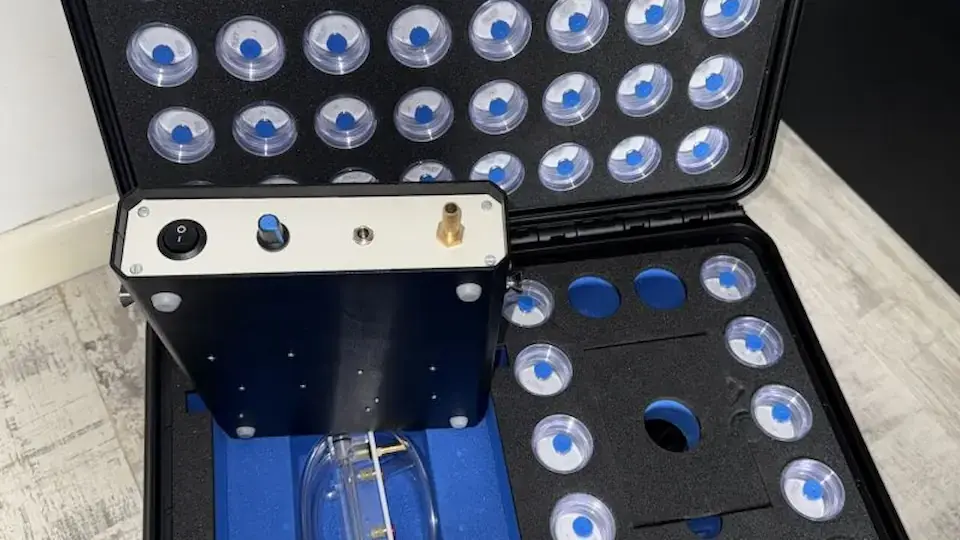
For environments where specific hazardous substances are used or generated — manufacturing, healthcare, laboratories, food production, and beyond — comprehensive indoor air quality testing is the most reliable method of understanding current exposure levels and identifying where the duty of care is at risk of being breached.
How can I ensure compliance with air quality regulations in my business?
Understanding which air quality requirements are mandatory, and which are simply recommended, is a good place to start when ensuring compliance. UK businesses are subject to legislation such as the Health and Safety at Work Act 1974 and COSHH, which place legal duties on employers to protect the health of their employees. Ignorance of these laws is not an excuse; if an employee is injured in the workplace due to avoidable risks, or risks are left in place without being remediated, the employer can see serious legal consequences.
Alongside these legal requirements are voluntary guidelines and industry standards that represent best practice for workplace indoor air quality. These aren't required, but they do help to reinforce an employers case by showing they are taking steps to ensure employee safety.
Being well-read across both can help you understand where your organisation should sit, whether you're aiming to meet minimum legal obligations or exceed them to create healthier, more productive spaces. Regular reviews of relevant legislation, appropriate risk assessments, and indoor air quality testing can all help businesses identify their responsibilities and demonstrate that suitable measures are in place.
Learn more about voluntary and mandatory responsibilities for air quality in the workplace.
The wider picture: general workplace air quality
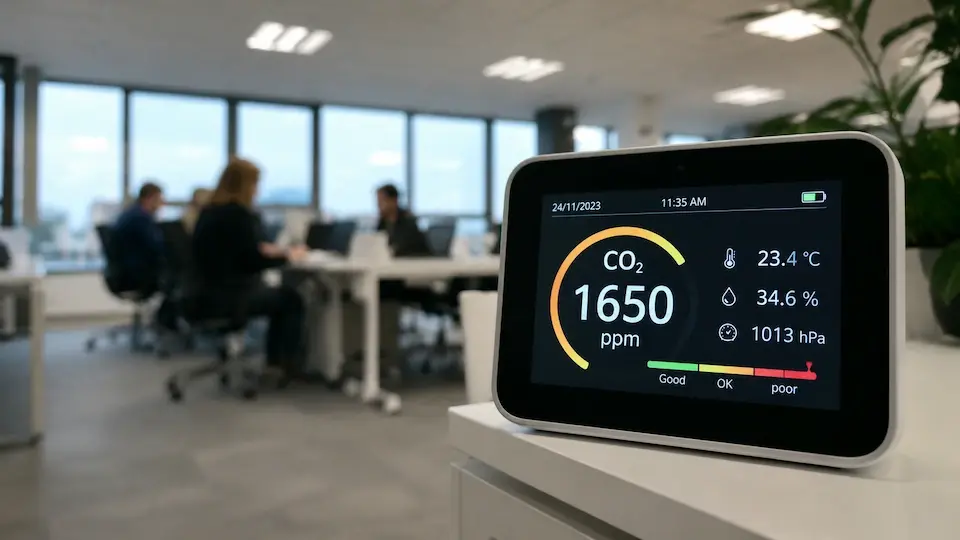
It is worth noting that the HSWA's reach is not limited to environments where identifiable hazardous substances are present. General indoor air quality — covering CO₂ accumulation, volatile organic compounds (VOCs), particulate matter (PM₂.₅ and PM₁₀), and biological pollutants — also falls within the employer's duty to provide a safe working environment.
Poor general air quality may not trigger COSHH in the same way that a defined hazardous substance does. But where the HSE can demonstrate that an employer knew, or ought to have known, that poor air quality was creating a risk to health and took no action, the HSWA's general duty remains engaged.
Indoor air quality monitoring allows employers to build a continuous, evidence-based picture of workplace air conditions — providing both the data to identify problems early and the records to demonstrate that reasonable steps are being taken.
Reach out to us for HSWA Advice
Understanding the law is the first step. Demonstrating compliance is the second — and that requires measurement.
ARM Environments specialises exclusively in indoor air quality. Our team provides WEL exposure testing, indoor air quality assessments, continuous IAQ monitoring, and ventilation validation across all sectors. Our CEO chairs BESA's Indoor Air Quality Group, placing ARM at the forefront of UK air quality standards and regulation.
If you have questions about your obligations under the HSWA, COSHH, or WELs, or if you need an expert air quality assessment to demonstrate compliance, get in touch with one of our specialists today.
Frequently Asked Questions
What is the Health and Safety at Work Act 1974 (HSWA)?
The HSWA 1974 is the primary piece of occupational health and safety legislation in Great Britain. It places a general duty of care on employers to ensure, so far as is reasonably practicable, the health, safety, and welfare of their employees and any other persons who may be affected by their work activities. All subsequent workplace health and safety regulations — including COSHH — are made under the authority of the HSWA.
What is COSHH and how does it relate to air quality?
COSHH — the Control of Substances Hazardous to Health Regulations 2002 — is the key regulatory framework governing how employers must assess, control, and monitor employee exposure to hazardous airborne substances at work. It requires employers to carry out risk assessments, implement adequate control measures, and monitor exposure levels. COSHH is a regulation made under the HSWA, meaning a breach of COSHH is simultaneously a breach of the HSWA's duty of care.
What is EH40/2005?
EH40/2005 is the HSE document — Workplace Exposure Limits — that lists over 500 hazardous substances alongside their assigned WELs. It is periodically updated and is the definitive reference document for COSHH compliance in relation to airborne substances. Compliance with EH40/2005 is not optional; it is a legal requirement.
Is air quality monitoring a legal requirement for employers in the UK?
Where employees are exposed to hazardous substances, employers have a legal duty under COSHH to assess and adequately control that exposure. Where the effectiveness of control measures cannot be confirmed without measurement — which is the case in most workplaces handling hazardous substances — WEL exposure testing and air quality monitoring are effectively mandatory. Employers who cannot demonstrate that exposures remain below WELs cannot demonstrate COSHH compliance.
What types of workplaces need WEL testing?
Any workplace where hazardous substances may become airborne is potentially in scope. This includes manufacturing, construction, laboratories, healthcare, food production, engineering workshops, commercial kitchens, and many office environments. ARM Environments provides WEL testing across all sectors and can advise on whether your environment requires formal assessment.
How often should COSHH assessments and WEL surveys be carried out?
COSHH assessments should be reviewed whenever there is a change to work processes, substances used, or control measures in place. For WEL monitoring specifically, testing frequency depends on the substances involved and the level of prior compliance demonstrated. General dust monitoring may be required every two years; more hazardous substances with narrower margins may require more frequent assessment. Annual monitoring is widely considered best practice for most environments.

![Your Guide to Indoor Air Quality Testing [2026]](https://www.arm-environments.com/hubfs/iaq%20testing%20in%20an%20office%20(1).webp)