Ammonia
- Sources
- Impacts
- Testing
Sources of Ammonia (NH3)
Ammonia (NH3) as a gas is unstable in the Earth’s atmosphere. It does not remain in an environment for long. Within a few hours, it reacts with other nitrogen oxides (NOx; NO2, NO) and sulphur dioxide to form the secondary pollutant PM2.5 (ammonia + nitric acid > ammonium nitrate particles), which persists for several days and can be transported over longer distances than ammonia.
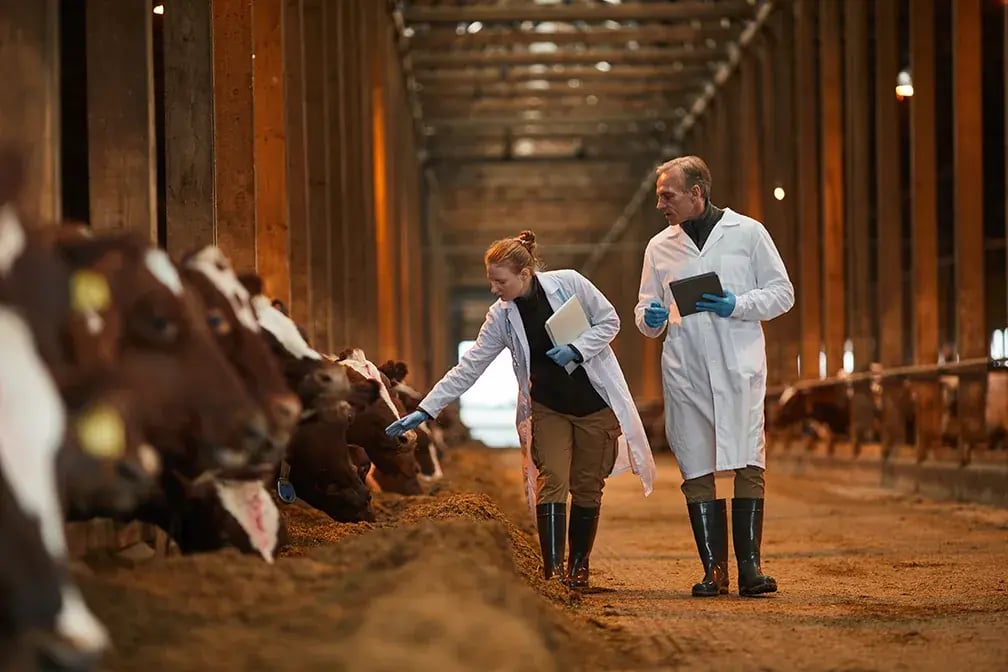
Estimating ammonia emissions is important to infer how much secondary PM is contributed to the environment. The vast majority of ammonia emissions in the UK (87%) originate from agricultural sources, including livestock, manure, urine, and inorganic fertilisers.
It occurs naturally at low levels in the environment, a result of the breakdown of organic matter. Smaller sources include waste, composting and domestic pets.
Ammonia may be produced by older catalytic converters when they remove nitrogen oxides.
Combustion of biomass may also produce ammonia. Ammonia is present in Earth's natural nitrogen cycle.
Ammonia is colourless and is lighter than air. It has a strong smell, similar to urine or sweat.
Typical Sources of NH3
- Agriculture
- Waste
- Biomass Decomposition
- Biomass Burning
Impacts of Ammonia (NH3)
Breathing in low levels of ammonia may irritate the eyes, nose and throat. High levels of ammonia may cause burns and swelling in the airways, lung damage and may prove fatal if a high enough dose (although rare) is inhaled. High concentrations may also cause corrosive damage to the skin. These levels are unlikely to be experienced within ambient indoor and outdoor air; you are more likely to be exposed to these levels in industrial and chemical industries.
Common Impacts of NH3
- Burning and Swelling of the ENT and Respiratory Tract
- Coughing, Nose, Throat and Eye Irritation
- Corrosive Damage To Skin
- Fatal Lung Damage (Extreme Dose)
Testing for Ammonia
Ammonia can be measured using fluorinated ethylene tubes, which contain an absorbent. The absorbent attracts ammonium ions. This sampling procedure takes 2-4 weeks, which can be seen as passive sampling.- Passive Diffusive Sampling
The Long-Range Transboundary Air Pollution’s amended Gothenburg Protocol (CLRTAP), the NECR and the National Emission Ceilings Regulations (2018) (NECR) require the UK to reduce ammonia emissions by up to 16% from 2005 to 2030. Ammonia only poses a direct risk to human health at very high concentrations, such as inside poultry sheds. Ammonia is more likely to react to form other gases. Clear Ammonia limits in the UK are not stated for indoor air in ambient settings. EH40/2005 states the limit for Ammonia (anhydrous) is 25 PPM.
- The EH40/2005 Limit is 25 PPM
Concerned About Ammonia?
Contact us today for expert advice and a professional survey.
Ammonia FAQs
Why Is Ammonia So Common In Agriculture? ↓
Ammonia is a key component of nitrogen-based fertilisers, its production made feasible with the discovery of the Haber-Bosch process in 1909. This process is currently responsible for half of the world’s food supply.
Indoor sources of ammonia are very minimal. Areas which may experience high levels of ammonia include intensive farming environments, chicken coops and barns. Working in wastewater treatment plants, dealing with sludge and industrial areas, may also expose you. Many of these spaces can be outside, so ventilation may already be to a good standard. If not outside, only spend a short period in such an environment, wearing PPE if needed.
What Legislation In The UK Specifies Ammonia Exposure Limits? ↓
EH40/2005.
How Do I Remove Ammonia from My Indoor Air? ↓
Bipolar ionisation is an air cleaning technology that effectively breaks down particles including ammonia, resulting in cleaner indoor air once implemented.
If outdoor ammonia reaches indoor spaces, ventilate if and when needed, be mindful of local activities within your area, which may produce ammonia.
Can I Percieve Ammonia? ↓
Why Is Direct Ammonia Exposure Not An Important Concern In Typical Life? ↓
Ammonia is emitted mostly in large outdoor areas with plenty of ventilation. It does not remain in the atmosphere for long at all, converting to other secondary pollutants such as Particulate Matter.
Why Choose ARM?
Though often short-lived, ammonia contributes to long-term PM2.5 risks. ARM offers reliable sampling and ventilation guidance to help you control exposure in agricultural, waste or nearby environments.
We are SafeContractor certified and part of BESA. With Adam Taylor – Chair of BESA’s Indoor Air Quality Group – at the helm, our approach is trusted, effective, and regulation-ready.