VOC Sampling vs Real-Time Monitoring: The Key To Accurate Air Quality Surveys
Understanding indoor air quality is not as straightforward as taking a single measurement and drawing a conclusion. Many buildings experience fluctuations in air quality throughout the day, influenced by occupancy, ventilation, and external factors.
To accurately assess these conditions, it is essential to use the right approach. VOC sampling and real-time air quality monitoring each offer valuable insights, but in very different ways. Knowing how they differ, and when to use each, is key to building a complete and reliable picture of your indoor environment.
Keep reading for our case study on how we deployed both systems to tackle a VOC concern at an office in Newquay, Cornwall.
What is VOC Sampling?
Volatile Organic Compounds are a broad category of pollutants in our air. Due to the sheer number of VOCs (which we measure as Total Volatile Organic Compounds, or TVOC for simplicity’s sake), we tend to lump them all together and measure them as a whole because individual identification can be tricky and time consuming.
It is, however, possible to measure specific VOCs via sorbent tube sampling. Typically, VOC sampling reports will detail the most important VOCs as many of them are less dangerous. The important VOCs, however, like formaldehyde and benzene (or any VOC which is likely to be in high concentration in the area based on the surrounding processes, like motorways or factories), do get measured individually with VOC tube sampling.
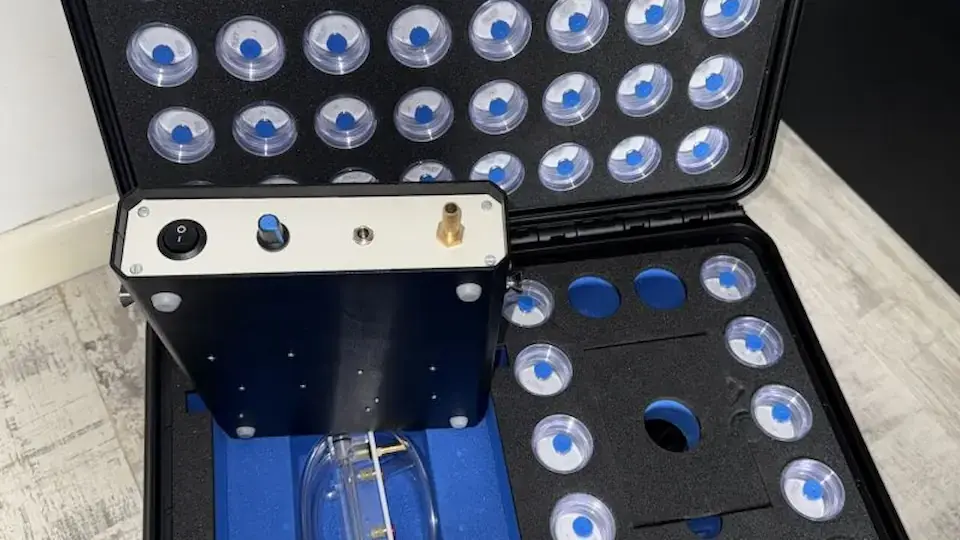
VOC sampling can be passive or active. Passive VOC sampling involves leaving an adsorbent tube somewhere indoors or outdoors to gather VOCs over a number of days or weeks, without the need for any maintenance or electricity. This provides a broad picture — the average conditions for the entire sampling period.
.webp?width=600&height=389&name=image%20(1).webp)
Active VOC sampling takes minutes and involves using a handheld device to take a “snapshot” of the air quality at that moment. Results can be transported to a lab for individual analysis, but only show the composition of the air at that exact moment, which can save a lot of time but isn’t very helpful at understanding changes to the air quality throughout the week.
.webp?width=600&height=419&name=image%20(2).webp)
For more information on VOC sampling, our blog on Air Sampling Methods for WEL Compliance covers the differences between active sampling, passive sampling, and real-time monitoring.
What is Real-Time Air Quality Monitoring?
Indoor air quality monitoring has its own benefits. Air monitors do not measure individual VOCs, but rather display a single TVOC figure. This means that it can be harder to identify root causes of VOCs within a space and the associated health risks, because we can’t track the specific VOC types.
However, digital air quality monitors win when it comes to understanding how your air quality changes over time. They often feed information to a digital dashboard which can be accessed remotely and typically provide continuous streams of data, showing spikes and troughs throughout the hours.
This can be incredibly useful at detecting hours in which air quality could be improved, or the best hours to open the windows to outside and ventilate the indoor space.
What’s the difference between VOC Sampling and IAQ Monitoring?
Having just explored how both VOC sampling and IAQ monitors operate, let’s discuss how they differ from one another:
- Passive VOC Sampling: Shows the composition of the air over a few days or weeks with specific VOCs being detected and measured
- Active VOC Sampling: Takes a snapshot of the composition of the air over the course of a few seconds or minutes
- Air Quality Monitors: Record the air quality over long periods of time, typically returning data to a digital dashboard where the charts can be viewed and easily inferred
All have their merits, but should be treated independently of one another and used in different scenarios. Whilst sampling VOCs gives you a clear view into the composition of the air (either in the short term with active sampling or long term with passive sampling), it doesn’t provide any insight into peaks and troughs day-to-day. Monitoring the air, however, provides clear transient data but doesn’t tell you which specific VOCs are present in your air.
Air Quality Monitoring in Cornwall: Case Study
Scope:
A perfect example of this dual-methodology in action is our recent investigation in Newquay. The goal was to verify the source of pollution driving the office’s odour complaints and to determine if outdoor pollutants were migrating indoors from a nearby airport.
To collect data on both the types of VOC (so we can trace the likely culprit) and the concentrations of VOCs throughout the week (so we can cross-reference against wind patterns and potentially identify where the pollution is coming from), we had to use both VOC sampling (we opted for passive sampling) and IAQ monitoring devices.
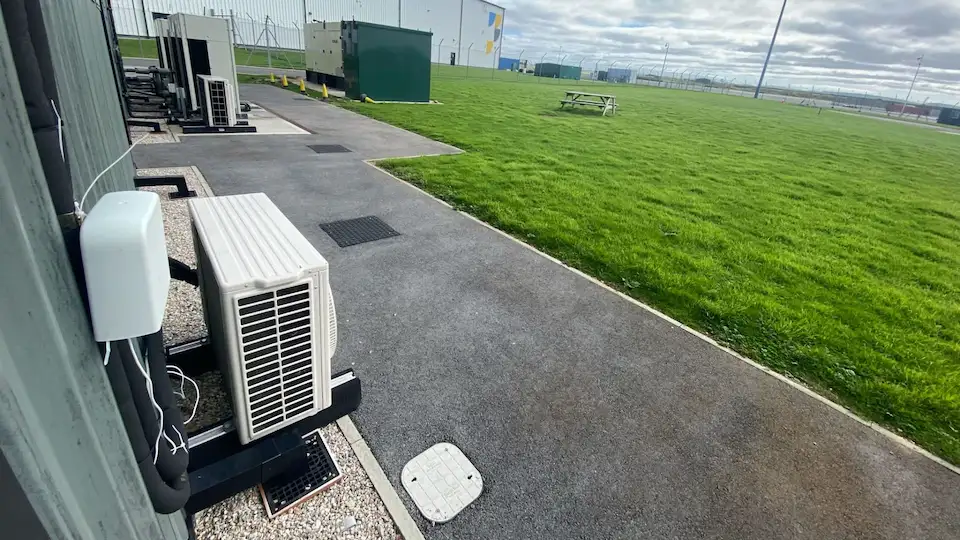
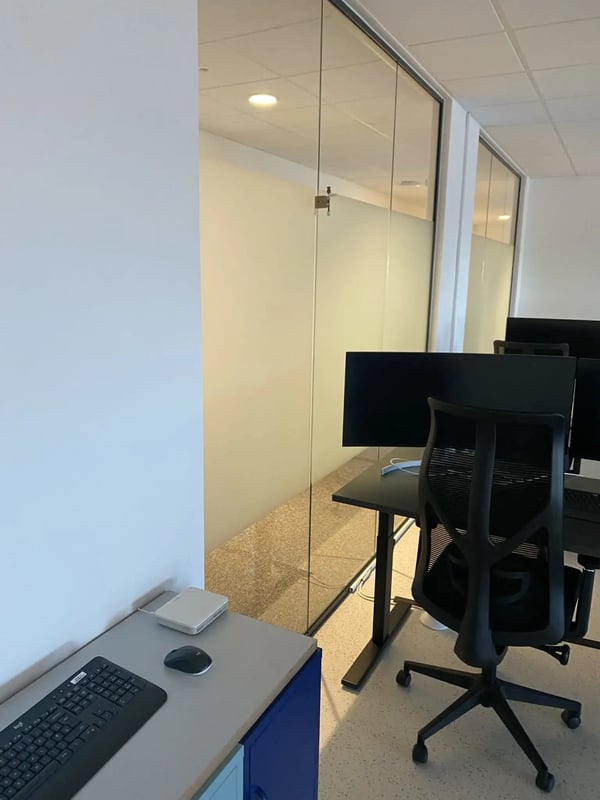
We chose to deploy each type of device both indoors and outdoors around the facility in hopes of collecting information on how the outdoor air is affecting the workers and visitors inside.
This dual approach allowed for:
- Continuous tracking of VOC levels
- Detection of short-term spikes
- Direct comparison between indoor and outdoor conditions
- Identification of potential health risks
Findings:
One of the key findings from the investigation was that TVOC concentrations were predominantly low, but subject to intermittent spikes. These spikes occurred under two specific conditions:
- When the ventilation system was switched off
- When external activities, such as aircraft refuelling, coincided with wind direction towards the building
This is a common but under-recognised issue in buildings experiencing intermittent air quality problems. From a compliance perspective, the building performed well; particulate levels were low, temperature and humidity were controlled; and carbon dioxide levels seemed acceptable during occupied periods.
Yet occupants still reported odour issues. The reason is straightforward. Human perception is highly sensitive to short-term changes in air quality. A brief spike in VOCs can be far more noticeable than a consistently moderate level. If you are only measuring averages, you are not measuring what people actually experience.
We also found through this investigation that the VOCs detected indoors, Cyclotrisiloxane, hexamethyl, and DEHP, typically associated with industrial lubricants, hydraulic fluids, PVCs, and plastic coatings, were detected in higher quantities when the wind direction blew air from the plane refuelling facility towards our client’s office. This indicated that heavily polluted air could enter the building in short bursts, affecting the indoor environment quality momentarily without appearing too significant on VOC sampling devices. Thanks to the IAQ monitors, we could link the wind patterns to the spikes in indoor VOCs and find the cause of the air quality complaints.
Conclusion: VOC Sampling vs IAQ Monitoring
VOC sampling and real-time air quality monitoring are often positioned as alternatives, but in practice, they serve entirely different purposes. Sampling tells you what is in the air, while monitoring shows you when and how air quality changes.
As the Newquay office investigation demonstrates, relying on one without the other can leave critical gaps in understanding. By combining both methods, it becomes possible to identify not only the presence of pollutants, but also the conditions that cause them to impact occupants.
Need Indoor Air Quality Monitoring?
If you are experiencing odour complaints, unexplained VOC levels, or inconsistent air quality, a combined monitoring and sampling approach might provide the answers.
Get in touch with ARM Environments to discuss how we can help you identify the source of your air quality issues and implement practical, data-driven solutions. Or, read more on our VOC Sampling service page.