
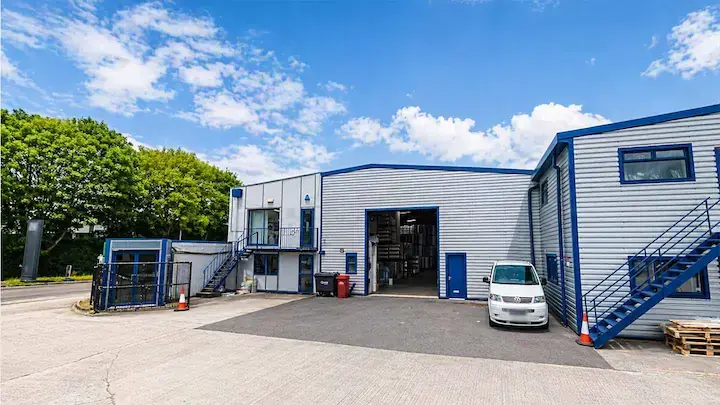
Air Quality Testing for VOCs in Wiltshire Industrial Site: Case Study
Poor air quality rarely announces itself dramatically. More often it builds quietly — shaped by the way a building was constructed, how its spaces connect, and the small daily habits of the people who work in it. A recent VOC air quality survey we carried out at an industrial estate in Wiltshire illustrated this perfectly, and delivered a finding that will be familiar to anyone who works near a manufacturing process: passing an EH40 compliance check does not automatically mean the air in your workplace is healthy.
Related pages:
The Wiltshire Site: An Office Adjacent to a Fibreglass Manufacturing Plant
The site in question was a fibreglass manufacturing plant on a Wiltshire industrial estate. Attached to the plant was an office space that had been partitioned off to create a separate working environment for office-based staff. On the surface, this seemed like a straightforward separation of industrial and administrative functions. In practice, the shared structure between the two spaces was allowing manufacturing emissions to migrate directly into the office with no meaningful barrier to slow them down.
The client commissioned ARM Environments to carry out a Volatile Organic Compounds (VOCs) survey to understand what their office workers were actually breathing, and whether the partition arrangement was creating a problem.
Learn more about our VOC Air Quality Surveys
How We Conducted the Wiltshire Air Quality Test for VOCs
We sampled across six locations around the site, testing for five specific compounds associated with fibreglass manufacturing and associated industrial processes: styrene, acetone, benzaldehyde, TXIB, and m/p-xylene. Sampling points included locations inside the manufacturing plant, the adjoining office, the first floor corridor, and an outdoor downwind reference point — allowing us to compare indoor concentrations directly against what the wind was already dispersing outside.
This multi-point approach is central to how we approach VOC surveys. Measuring at a single location, or only at source, would not have captured the full picture of how pollutants were moving through the building.
Learn more about harmful pollutants.
What the VOC Air Quality Survey Found: Compliant, But Not Clean
All five compounds came in well within EH40 workplace exposure limits — the regulatory benchmark for occupational VOC exposure in the UK. On paper, the site was compliant. In practice, the situation in the office was considerably more concerning.
Styrene concentrations in the adjoining office and the first floor corridor rose well above typical ambient levels of around 50 µg/m³, and critically exceeded the odour recognition threshold of 210–280 µg/m³. At these concentrations, workers are likely to experience symptoms including dizziness and irritation to the throat and eyes — even though the readings fell short of the EH40 limit.
Acetone and several other compounds were also measurably and consistently higher inside the adjacent office than at the outdoor downwind reference point, where wind was rapidly diluting the same emissions to insignificant levels.
The outdoor air was fine. The indoor air — just metres away, separated by a partition wall — was not.
"The lesson here is that acceptable outdoor conditions and regulatory compliance do not automatically translate into healthy indoor environments. Seemingly minor building design choices such as shared structures can amplify low-level emissions into a persistent indoor air quality problem with real impacts on comfort and health. Layout changes like these typically call for a ventilation survey to verify the air is still safe."
Adam Taylor, CEO
Why the Office Had a VOC Problem, but the Outdoors Didn't
The root cause was straightforward once the data pointed us towards it: the building itself. The office had no mechanical ventilation, and windows were rarely opened. Pollutants migrating through the partition from the manufacturing plant had nowhere to go. Outside, the same compounds were being dispersed by wind almost as quickly as they were produced. Inside the office, they simply accumulated.
This is one of the most important lessons in indoor air quality work: outdoor dilution and indoor accumulation are entirely different processes, and a building that sits between a pollution source and the open air can trap and concentrate emissions to a degree the outdoor environment never would. Regulatory frameworks, including EH40 limits, are typically derived from occupational exposure studies — they are not designed to account for the compounding effect of poor ventilation in an enclosed space adjacent to an emission source.
Our Air Quality Recommendations for the Wiltshire Site
Based on the survey findings, we made two principal recommendations:
1. Improve ventilation to the adjacent office
Introducing a reliable source of mechanical ventilation — or at minimum ensuring consistent window ventilation — would significantly reduce the concentration of infiltrating VOCs by replacing stagnant indoor air with fresh outdoor air on a regular basis.
2. Improve airtightness between the two partitioned spaces
Reducing the transfer of pollutants at source — by sealing gaps and improving the integrity of the partition structure — would address the problem upstream, limiting how much manufacturing off-gassing can migrate into the office environment in the first place.
Together, these measures tackle the issue from both ends: reducing ingress through the structure and improving removal of any pollutants that do find their way in.
Taking the Right Approach to Testing for VOCs
This Wiltshire case study is a useful illustration of why a holistic approach to air quality surveying is so important, particularly in industrial and mixed-use settings. Measuring emissions at source — or checking against regulatory limits alone — tells only part of the story. Understanding how a building's internal layout, ventilation provision, and structural connections influence the movement of pollutants is just as critical to protecting the people inside it.
An office that looks entirely separate from an industrial process may, in practice, share more air with it than anyone realises. Without proper monitoring, that risk is effectively invisible.
Our Assess, Remediate, Maintain framework provides a unique holistic approach to ensure indoor environments don't suffer from easily preventable air quality problems like this one.
Learn more about the ARM framework here.
VOC Air Quality Surveys in Wiltshire
If your workplace is located near a manufacturing process, uses industrial chemicals, or operates in a mixed-use building where spaces share structural elements, a professional VOC survey could reveal risks that standard compliance testing won't catch. ARM Environments carries out detailed, multi-point VOC air quality assessments tailored to your site and sector, giving you the data to protect your workforce and make informed decisions about ventilation and building management.
Get in touch to discuss an air quality survey or VOC assessment for your Wiltshire site or industrial premises elsewhere in the UK.
See next: Mould Testing in South West London: Case Study

![Your Guide to Indoor Air Quality Testing [2026]](https://www.arm-environments.com/hubfs/iaq%20testing%20in%20an%20office%20(1).webp)