How to Avoid Pressure Drop when Combining ePM10 & Molecular Filters
Facilities and property managers running combined particulate and molecular filtration often find the same thing: the filter gauge looks fine, but gaseous pollutants (VOCs, odours, NO₂) are still getting into the building. Nothing on a standard maintenance schedule flags this, because filter changes are driven by dust loading, not gas adsorption.
Integrating molecular filtration into an air handling unit (AHU) often means adding a significant pressure drop, because a separate molecular filter stage means air has to pass through an extra bank of media. That extra resistance means the AHU's fan has to work harder to move the same volume of air, which pushes up energy use and running costs.
Combined particulate and molecular final filters solve this by putting both functions in one filter stage instead of two, but the active carbon weight in them is low, so they quickly become saturated and ineffective at removing gaseous pollutants long before the particulate filter has reached the end of its useful life.
How each filter type works
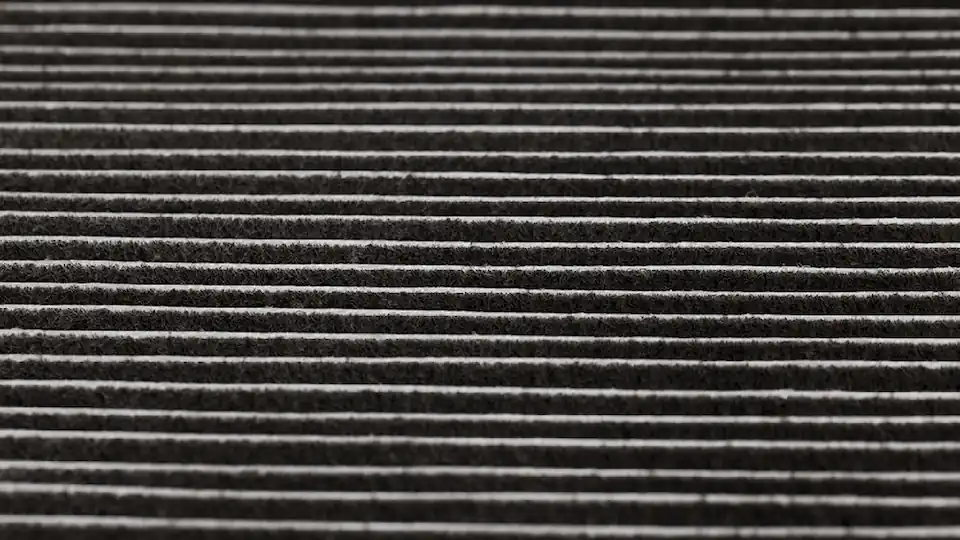
Particulate filters (rated ePM10 under ISO 16890) work mechanically, trapping fine dust, pollen and other airborne particles as air passes through the media. They get more efficient as they load up with dust, right up until the pressure drop across them becomes too high and they need replacing.
Molecular filters work differently. They rely on activated carbon, a highly porous material that adsorbs gas molecules onto its surface rather than trapping solid particles. This is what allows them to remove VOCs, odours and NO₂ that a particulate filter can't touch. But adsorption capacity is finite: once the carbon's surface is full, it stops adsorbing, regardless of how much air has passed through or how the filter looks.
Why the carbon runs out early
Carbon has a fixed adsorption capacity. Once it's saturated, it stops removing gaseous pollutants — but the particulate filter can carry on working for weeks or months longer. In a final filter with low carbon weight, that gap can be substantial, and there's no gauge reading that tells you it's happened.
Read more about how molecular filters are rated in ISO 10121-3.
Why we put the carbon in the pre-filter
Because of the fixed adsorption limit, we incorporate active carbon into the pre-filter. Pre-filters are changed more readily than final filters, so the point at which the molecular filter loses efficiency is more aligned with when the particulate filter has reached its efficient dust holding capacity.
Combined ePM10-Molecular filters available
Our combined ePM10-molecular filters are currently available in the following sizes:
- 287 x 596 x 47
- 496 x 596 x 47
- 596 x 596 x 47
We will be adding deeper filters soon to further increase the life and performance of these units.
See our ePM10 & Molecular filter page for more details on how to purchase them.

![Your Guide to Indoor Air Quality Testing [2026]](https://www.arm-environments.com/hubfs/iaq%20testing%20in%20an%20office%20(1).webp)